Radio / Speech — orders & AWACS chatter¶
The in-game voice: the message queue (MSG*) that carries every order and event
between planes, and the speech layer (SAY*) that turns a queued message into a HUD
line plus a played .5K radio clip. This is what produces wingman comms, AWACS/GCI calls,
low-fuel and rearm prompts, and the running combat chatter.
Provenance: Ghidra static analysis of the game executable with FA.SMS symbols applied; recorded in the symbol database and applied to the Ghidra project. Progress: reconstruction matrix. Markers follow spec-authoring.md: confirmed · inferred · unknown.
The message queue (MSG*, #493)¶
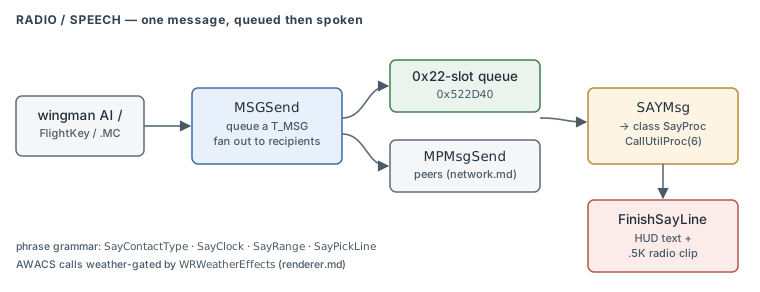
MSGSend (0x4180A0, the subsystem's largest function) is the single primitive behind
every order and combat event. It queues a T_MSG record into a fixed 0x22-slot table
(0x522D40, stride 0xD5; the +6 fire-time word is 0xFFFF when the slot is free):
confirmed
T_MSG  +0x00 u8   flags (bit0 = silent, bit2 = from-network)
       +0x01 u8   random salt (line variation)
       +0x02 u16  fromId
       +0x04 u16  toId
       +0x06 u16  fireT   (_currentT + delay; 0xFFFF = empty slot)
       +0x08 u16  param
       +0x0A u8   kind    (the SayProc opcode — see below)
       +0x0B i16  payloadLen (<=200)
       +0x0D …    payload
Recipient addressing is the interesting part: a toId of 0x8000/0x8001/0x8002 is not
an object — it fans out through WNGPart/WNGWingmen/WNGLeader to the leader, the
whole wing, or the wing-minus-sender; 0x8003 + thisComputer addresses a specific human
station; 0x800B is an any-AI wildcard used by MSGReceive. Local AI recipients are
serviced immediately (ImmediateService); non-local recipients are mirrored to peers by
MPMsgSend. If the message is addressed to the player and audible, MSGSend also calls
SAYMsg so the player hears it. confirmed
MSGReceive pulls the first due message matching a recipient mask; MSGMultiGet/
MSGMultiCanGet are the multiplayer relay path; MSGHide/MSGPop bracket a burst of
orders so only the net effect is spoken; MSGRemoveCurObj/MSGRemoveSecondaries are the
death/cleanup purges. MSGSendChatter (owned by network.md as a shipped-.MC
import) is the mission-script entry point that sends a chatter line to a wing. confirmed
The speech layer (SAY*, #493)¶
SAYMsg (0x48D350) renders one queued message: it pushes the sender as the current
object and dispatches to that object class's SayProc via CallUtilProc(6) — the
OBJSayProc dispatch slot objects.md names but never followed. The procs
live with the object system (_PLANESayProc 0x48D780, _OBJSayProc 0x48E8D0,
_PLANECommentProc 0x48EC40), and each builds a line out of the shared SAY helpers
documented here. confirmed
Line construction is a small phrase grammar, assembled into two accumulators (text at
0x552FF0, a comma-separated .5K sound-name list at 0x553050) and flushed by
FinishSayLine/SayFlushLine: confirmed
SayPickLinechooses one of N alternative lines for a topic — random when there is no sender, otherwisesenderId % Nso a given plane says it consistently.SayContactTypebuilds "N bandit(s)", special-casing MiG-17/19/21 by type-name prefix and appending the aspect word from the target's facing bits.SayClock/SayRange/SaySpellNumber/SayNumberWordare the "your 3 o'clock, high", "2 miles", digit-spelling, and number-word builders.SayContactCallandSayWaypointCallassemble the full AWACS "Contact, multiple bandits, …, please advise" and "Proceed to waypoint N, bearing X, descend to angels Y" transmissions — both weather-gated byWRWeatherEffects(see renderer.md § Weather), so a call only reports what the caller could actually see.
FinishSayLine prefixes the speaker's callsign (SayObjName; "CO-PILOT"/"VOICE" for the
player), HUDMessages the text, plays the .5K list at radio volume, and arms the chatter
cooldown (SayScaleTime scales it by time compression). SayFlushLine additionally
re-sends the line over the network so remote players hear it. confirmed
Fixed lines. SAYLowFuelMessage is the Joker/Bingo/"running on fumes"/"out of gas"
ladder, each fired once via plane-flag latch bits; SAYRearmMessage, SAYSuppRadarMessage
(AWACS/GCI link on/off/broken), and the Fort reports (SAYFortAircraft/SAYFortStatus)
round it out. SAYTranslate swaps an English distress clip for its Russian equivalent when
the player flies a MiG (side 0x14/0x15). confirmed
Functions¶
Full record: db/symbols/radio.csv.
| VA | Symbol | Role |
|---|---|---|
0x4180A0 |
MSGSend |
queue an order/event to one or a fanned-out recipient set |
0x4185A0 |
MSGReceive |
pull the first due message for a recipient mask |
0x48D350 |
SAYMsg |
render a queued message via the object SayProc |
0x48D470 |
FinishSayLine |
speak the assembled line (HUD text + .5K audio) |
0x48E740 |
SayContactCall |
the full AWACS contact call (weather-gated) |
0x48EB20 |
SAYLowFuelMessage |
the Joker/Bingo/fumes/out-of-gas ladder |
0x490F30 |
SAYTranslate |
English→Russian distress-clip swap for MiG players |
Open Questions¶
1. The SayProc bodies are owned by the object system¶
_PLANESayProc / _OBJSayProc / _PLANECommentProc (the per-class line generators, and
_PLANECommentProc's 2.6 KB of unscripted air-combat banter) are claimed in
db/symbols/objects.csv
with their chatter-state globals (_sayLastComment, _sayCommentUntil, …). They dispatch
through this subsystem (SAYMsg → CallUtilProc(6)) but are documented as object
behaviour. The split is deliberate; this doc is the transport + phrase-grammar half.
Status: resolved (by design) — the procs live with objects.md; the pipeline is here.
2. The kind opcode table¶
PLANESayProc's switch enumerates the message kinds (5 break, 6 approach, 0xB engage,
0x12 firing, 0x14 splash, 0x1C in-range, 0x1F mission-accomplished, …). They are the same
opcodes FlightKey and the wingman AI pass to MSGSend; a consolidated kind→line table
would be a useful reference but is mechanical to extract.
Status: open — re-static (tabulate the PLANESayProc/PLANECommentProc kind switch).
Related¶
- objects.md — the SayProc dispatch slot and the per-class line generators.
- wingman.md — the wing/group AI that issues most orders via
MSGSend. - network.md —
MSGSendChatterand theMPMsgSendpeer mirror. - renderer.md —
WRWeatherEffects, the visibility model AWACS calls respect. - chat.md — the human multiplayer chat that rides the same
MSGSendpath.