Cockpit sensors — radar / IR / RWR¶
The sensor simulation: what the player is allowed to see. Every frame the engine scores every object into a radar and an infra-red signature, decides which sensors can detect it, and files the survivors into the scope buffers the cockpit MFDs draw from. This is the producer of the HUD symbology and the input to the weapons seeker/lock model — both of which were documented while the model that feeds them was not (#486).
Provenance: Ghidra static analysis of the game executable with FA.SMS symbols applied; the
CP*functions are recorded in the symbol database and applied to the Ghidra project. This subsystem is complete — the RCS model, the three detection predicates, the RWR timing, and the scope renderers are traced (#486) and every function in its range is claimed; a few per-MFD-type layout attributions of theCPScopeHelper*primitives remain as a follow-up. Confidence markers follow spec-authoring.md: confirmed · inferred · unknown.
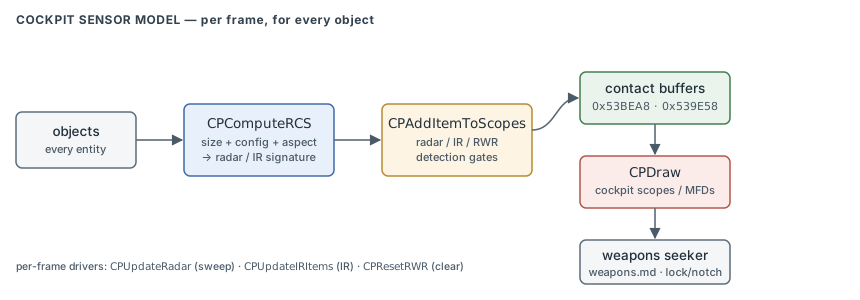
The model¶
1. Signature — _CPComputeRCS@8 (0x43E8C0). CPComputeRCS(entity *target, int mode)
returns the target's radar signature and computes its IR signature alongside, summing
contributions from:
- base size — read from the target's type record (
entity+5→ type field+0x45), bucketed into small / medium / large; - configuration — the
+0x16FHUD/state flags: gear down (0x40), weapon-bay open (0x200), and the afterburner/heat bit (0x80) each add to both signatures; - aspect — pitch (
entity+0x1F) and bank (entity+0x21) shift the signature with viewing angle; - damage — a damaged airframe (
entity+0x10 & 0x80, past half damage) is louder on both bands; - class extension —
entity+0xDE & 0x10(the per-class extension, #476) adds a fixed increment.
2. Detection gate — @CPAddItemToScopes@4 (0x43DEE0). Per candidate object it runs three
independent detection tests (radar, IR, RWR) and inserts each pass into the matching contact buffer
via a shared insert routine. Two buffers hold the results: the radar+IR scope list at 0x53BEA8
and the RWR list at 0x539E58 (each 0x6D6 = 1750 dwords).
3. Per-frame drivers. _CPUpdateRadar@0 (0x43E810) timestamps the sweep and clears the
accumulator; ?CPUpdateIRItems (0x440FE0) refreshes the IR-seeker contact list;
_CPResetRWR@0 (0x43E830) zeroes both buffers and re-arms the scan timers.
4. Presentation — _CPDraw@8 (0x439220). Renders the radar/IR/RWR scopes and the cockpit
MFDs from the contact buffers, through the window dispatcher below.
Detection predicates (#486)¶
CPAddItemToScopes runs exactly three independent predicates per candidate object, and files
each pass through the shared CPScopeInsert (dedup-and-update by object id): confirmed
CPRadarSees(0x43DF70) — the player's own radar. The target must be alive and radar-detectable (type field+9bit0x20), pass the mode-specific look-down filter (_radarModeat0x5387D8— its value selects ground-clutter handling and the scan-bounds box,0x5387E0look-up vs0x539D78look-down), lie inside the radar-beam FOV (PROJInFOV), and not be terrain-blocked (COLTerrainBlocking). Detection range is set by the target's RCS at type+0x3B(RCS × 0x30000vs range for the wide mode), so the sameCPComputeRCSsignature that draws the return also gates whether it is seen. Chaff (aGRAPHICof type0xC/0xD) always paints.CPSuppRadarSees(0x43E220) — the AWACS/GCI datalink, active only whenUsingSuppRadar. A wider bounds box, filed into the same radar scope as a datalink contact.CPRwrSees(0x43E330) — the RWR, i.e. what is illuminating you. A SAM/AAA site (class 6) registers when its emitter is on (type+0xA6bit 1), it is not in a non-emitting state, its emitter name is not excluded, and it is within0x76AC00; a hostile plane (class 2/4) registers when it is radar-capable and carries the radar-locking-me flag (entity+0xDEbit0x400). This is why the RWR shows threats the plain radar scope does not.
Scopes & the RWR display (#486)¶
CPDraw renders each cockpit MFD through CPDrawWindow (0x43A190), a dispatcher that
switches on _windowTypes[i]: the radar B-scope / target-designation views route to
CPDrawRadarScope (0x43A5C0, the largest renderer — it walks the radar buffer, resolves
the designated target and the selected-weapon lock, and is itself weather-gated through
WRCanSee, see renderer.md), and window
type 10 routes to CPDrawRWR (0x43EA40). The RWR display refreshes every 0x40 ticks and
draws the threat ring plus the aircraft's own RCS diamond from _frontRCS/_sideRCS; each
contact is coloured by lock state — a track lock is red (0x2B) and a search lock
yellow (0x2C) until _currentT passes _trackLockEndT / _searchLockEndT. That pair of
timers is the RWR spike timing: the launch/lock warning holds for the interval the emitter
keeps painting you. WPCInit (0x438870) lays out the MFD window rectangles from the screen
resolution, and CPNextTarget (0x440E10) cycles the radar buffer for the t/T keys. confirmed
Functions¶
Full record: db/symbols/cockpit-sensors.csv.
| VA | Symbol | Role |
|---|---|---|
0x43E8C0 |
CPComputeRCS |
radar-cross-section + IR-signature model |
0x43DEE0 |
CPAddItemToScopes |
radar/IR/RWR detection gate → contact buffers |
0x43E780 |
CPRemoveItemFromScopes |
drop a contact from the scopes |
0x43E810 |
CPUpdateRadar |
per-frame radar sweep state |
0x440FE0 |
CPUpdateIRItems |
per-frame IR-contact refresh |
0x43E830 |
CPResetRWR |
clear the scope + RWR buffers, re-arm timers |
0x439220 |
CPDraw |
render the scopes / cockpit MFDs |
0x438B70 |
CPInit |
allocate buffers, reset the scopes |
0x43DDD0 |
CPRadarRange |
current radar range setting |
0x43E7E0 |
CPBombRange |
current bomb-range / CCIP setting |
0x43DE10 |
UsingSuppRadar |
is the supplementary radar in use |
0x43DE90 |
CPSetSkill |
radar/AI skill level |
0x438520 |
CPSetMissile |
set the selected missile on the scope |
0x43DF70 |
CPRadarSees |
radar detection predicate (look-down / FOV / terrain / RCS range) |
0x43E330 |
CPRwrSees |
RWR detection predicate (is this emitter illuminating me) |
0x43A190 |
CPDrawWindow |
cockpit MFD window dispatcher (per _windowTypes[i]) |
0x43A5C0 |
CPDrawRadarScope |
radar B-scope / target-designation MFD (weather-gated) |
0x43EA40 |
CPDrawRWR |
RWR threat display + track/search lock spike timing |
0x440E10 |
CPNextTarget |
cycle the radar contact buffer (t/T keys) |
0x441160 |
CPGetContact |
fetch a contact from the CP scope buffer |
Open Questions¶
1. CPDraw home — sensor or HUD? (resolved: stays)¶
_CPDraw@8 (0x439220) and the CPDrawWindow/CPDraw*Scope family render the MFDs, which is
symbology work like hud.md. But the read (#486) shows the renderers are inseparable
from the contact buffers and the detection state they walk — CPDrawRadarScope resolves the
designated target and the selected-weapon lock, CPDrawRWR reads the lock timers — so the draw
side belongs with the sensor model that produces it, not with the flat HUD symbology. It stays
in this subsystem.
Status: resolved — re-static (#486; the scope renderers are sensor-coupled, kept here).
2. Detection thresholds & RWR spike timing — resolved¶
The three predicates and the RWR timing are now read (see § Detection predicates and
§ Scopes): radar detection is a look-down-mode + beam-FOV + terrain-blocking + RCS-range test,
the RWR shows emitters carrying the radar-locking-me flag, and the spike timing is the
_trackLockEndT / _searchLockEndT pair (red track lock 0x2B, yellow search lock 0x2C).
The remaining CPScopeHelper* primitives are named but their individual MFD layouts (which
window type is the HSI, the TID, etc.) are only partially attributed.
Status: resolved — re-static (#486; per-MFD-type layout attribution is a follow-up).
Related¶
- weapons.md — the seeker/lock model that consumes this state (
PROJTargetSignal,PROJIRSensorOn,PROJInNotch). - hud.md — the cockpit symbology that draws the sensor output.
- structs.md — the entity fields
CPComputeRCSreads (+0x16Fflags,+0x1F/+0x21aspect,+0xDEextension).