T2 — Terrain Map (.T2)¶
FA_2.LIB contains 16 .T2 files — one per theater. Each stores the terrain
grid data (height, color, surface type) for a campaign area. Referenced by
.MM theater files via the map keyword (e.g. map apa.T2).
Tools¶
fx¶
fx t2 info      <file.T2>            # grid, elevation range, surface classes
fx t2 dump      <file.T2> [--leaves] # records as CSV (summaries / full leaf grid)
fx t2 heightmap <file.T2> <out.png>  # leaf elevation bands as grayscale PNG
The fx_lib read API (t2_read, api.md § t2.h) decodes the
full map — header strings, the per-leaf records, and the per-tile summary
array — losslessly: header + records reassemble the file byte-identically
(proven over all 16 stock theaters).
fxs¶
The fxs asset viewer previews a .T2 as a textured 3D terrain — the leaf
grid as a heightfield (elevation band → height), each leaf textured with its
texture_variant tile through the shared fx_render module
(§ Terrain Texturing below). Open the theater's texture LIB alongside the map
(tiles ship in a sibling LIB) so the tiles resolve. See
gui.md § T2 terrain.
File Layout¶
All multi-byte integers are little-endian.
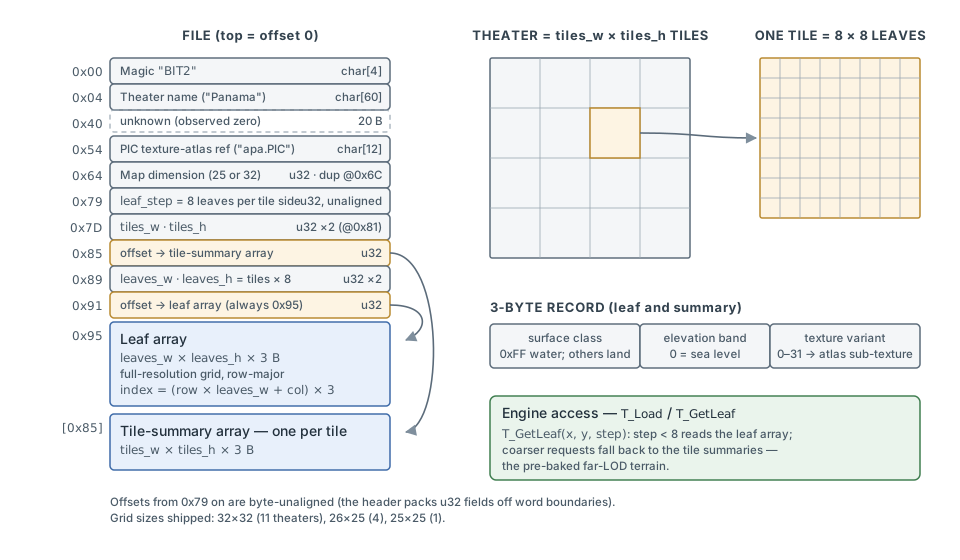
Header¶
| Offset | Size | Type | Description |
|---|---|---|---|
0x00 |
4 | char[4] | Magic BIT2 (ASCII, no null) |
0x04 |
60 | char[60] | Theater name, null-padded ASCII (e.g. "Panama") |
0x40 |
20 | u8[20] | Reserved — never read by T_Load/T_GetLeaf; all-zero in every theater |
0x54 |
12 | char[12] | PIC texture atlas reference, null-padded ASCII (e.g. "apa.PIC") |
0x60 |
4 | u32 | Reserved — unread by the loader/sampler; 0 in every theater |
0x64 |
4 | u32 | Map dimension (tile columns = tile rows; 25 or 32) — a descriptive copy; the sampler reads the authoritative tiles_w/tiles_h at 0x7D/0x81 |
0x68 |
4 | u32 | Reserved — unread by the loader/sampler; 0 in every theater |
0x6C |
4 | u32 | Map dimension (duplicate of 0x64) — also descriptive, not read by the sampler |
0x70 |
8 | u8[8] | Reserved — never read by T_Load/T_GetLeaf; all-zero in every theater |
0x79 |
4 | u32 | leaf_step — leaves per tile side (8 in all theaters). (The old "0x78 = always 2048" reading was this field misaligned by one byte: 8 << 8.) |
0x7D |
4 | u32 | tiles_w — tile grid width (the old "0x7C = cols × 256" reading was this field misaligned) |
0x81 |
4 | u32 | tiles_h — tile grid height |
0x85 |
4 | u32 | File offset of the tile-summary array (tiles_w × tiles_h × 3 bytes; the payload tail) |
0x89 |
4 | u32 | leaves_w = tiles_w × leaf_step |
0x8D |
4 | u32 | leaves_h = tiles_h × leaf_step |
0x91 |
4 | u32 | File offset of the leaf array (leaves_w × leaves_h × 3 bytes) — always 0x95 |
0x95 |
— | Terrain data payload: the two flat arrays (structure below) |
Map Sizes¶
| Grid (w×h) | Files | tiles_w ([0x7D]) |
tiles_h ([0x81]) |
tiles | File size |
|---|---|---|---|---|---|
| 32×32 | 11 | 32 | 32 | 1024 | 199,829 B |
| 26×25 | 4 (EGY/FRA/UKR/VLA) | 26 | 25 | 650 | 126,899 B |
| 25×25 | 1 (TVIET) | 25 | 25 | 625 | 122,024 B |
When addressing tile (col, row): tile_index = row × tiles_w + col
(T_GetLeaf indexes both arrays row-major).
Data Payload¶
The payload is two flat row-major arrays of 3-byte records (field map
above; the engine's T_Load @0x4C5D70 relocates the two offsets into
pointers, and T_GetLeaf @0x4C6040 indexes both arrays as
(row × width + col) × 3):
| Offset | Size | Contents |
|---|---|---|
0x95 ([0x91]) |
leaves_w × leaves_h × 3 |
Leaf array — the full-resolution terrain grid (8×8 leaves per tile) |
[0x85] |
tiles_w × tiles_h × 3 |
Tile-summary array — one coarse record per tile |
T_GetLeaf(x, y, step) reads the leaf array while step < leaf_step and
falls back to the tile-summary array (indexing by x / leaf_step,
y / leaf_step) for coarser requests — the summaries are the pre-baked
far-LOD representation.
Superseded readings. Earlier revisions described the payload as a "21-byte sub-header + N_tiles × 195-byte tiles". That cut was an artifact: the "sub-header" was the tail of the real header field map above (its mysterious "class constants — one fixed value per grid-size class" decode exactly as the array offsets and leaf-grid dimensions, which are pure functions of the grid size), and the "195-byte tile with an interleaved summary record" does not exist — leaves are stored globally row-major, and the per-tile summaries live in the separate tail array. The old "record 0 selection algorithm" mystery dissolves with it: the summaries never sat among the leaves in the first place.
3-Byte Record (leaf and tile-summary)¶
| Byte | Field | Values / Notes |
|---|---|---|
| 0 | Surface class | 0xFF = water/ocean (all theaters); 0xD2 = land (APA, IRA, GRE, NSK, LFA — single land type); 0xD0–0xDA = multiple land classes (EGY, UKR: sand, rocky, dunes, etc.); 0xC2, 0xC4–0xC7 = land classes (TVIET: jungle, paddy, savanna, etc.) |
| 1 | Elevation band | 0 = sea level / coastal; higher = altitude above sea. Max observed per theater: APA=12, GRE=4, IRA=6, EGY=6, NSK=12, LFA=4, UKR=6, TVIET=16. Water leaves (class 0xFF) carry bands too — almost all 0–1, with a handful of elevated water leaves in GRE/LFA/PGU/WTA (inland lakes, up to band 9 in WTA) |
| 2 | Texture variant | 0–31; selects a sub-texture within the PIC atlas for this surface class |
File Inventory¶
| File | Name | Grid |
|---|---|---|
| APA.T2 | Panama | 32×32 |
| BAL.T2 | The Baltics | 32×32 |
| CUB.T2 | Cuba | 32×32 |
| EGY.T2 | Egypt | 25×26 |
| FRA.T2 | France | 25×26 |
| GRE.T2 | Greece | 32×32 |
| IRA.T2 | Iraq | 32×32 |
| KURILE.T2 | Kuril Islands | 32×32 |
| LFA.T2 | Falkland Islands | 32×32 |
| NSK.T2 | North/South Korea | 32×32 |
| PGU.T2 | Persian Gulf | 32×32 |
| SPA.T2 | Pakistan | 32×32 |
| TVIET.T2 | North Vietnam | 25×25 |
| UKR.T2 | Ukraine | 25×26 |
| VLA.T2 | Vladivostok | 25×26 |
| WTA.T2 | Taiwan | 32×32 |
All 16 live in FA_2.LIB. The PIC reference names the texture atlas used for
terrain tile rendering. Each theater has a matching .PIC file with the same
base name (e.g. APA.T2 → apa.PIC).
Engine Notes¶
Loader and grid sampler (resolved 2026-07-05)¶
The two long-standing open questions were resolved statically (#262):
- Sub-header "class constants" — decoded as the header field map above
(
leaf_step, tile/leaf grid dimensions, and the two array offsets), read byT_Load(0x4C5D70) /T_GetLeaf(0x4C6040). The earlier literal scan (0x95,0x80,195,21) missed the loader because the engine's fields sit at0x79–0x94and no 195-byte stride exists. The values are pure functions of the grid size — why every theater of a size class shared them byte-for-byte. - Tile summary record selection — no selection happens: the summaries
are a separate authored far-LOD array at
[0x85], returned byT_GetLeafwhen the requested step reachesleaf_step. The "interleaved record 0" was a mis-cut of the flat leaf array.
Header field-access set (resolved #132).
T_Load reads exactly two header words — it relocates the tile-summary and leaf
offsets at +0x85/+0x91 into pointers (*(ptr) += _th) and derives the
<theater>land.PIC name; it takes the theater name from the mission, not the
0x04 field. T_GetLeaf then reads only leaf_step (+0x79), the two grid
dimensions (+0x7D/+0x81), the leaf extents (+0x89/+0x8D), and the two
relocated pointers. No engine path reads the interspersed fields at
0x40/0x60/0x68/0x70 — they are reserved padding, which is why every
shipped theater leaves them zero. This closes the old "world-space bounds"
hypothesis: the grid is addressed purely by the relocated array offsets and the
leaf/tile dimensions, with no world-space extent field consumed.
Terrain Texturing¶
Per-leaf tile → PIC atlas. The mechanism, from static RE + asset inspection; intent is not recovered.
Each leaf's texture variant (byte 2 of the 3-byte record) selects a numbered
theater texture tile <theater><N>.PIC — a 256×256 palette-less indexed
dense PIC (APA0.PIC … APA25.PIC for Panama; LAND.PIC is the shared
fallback). T_Load (0x4C5D70) resolves the theater's textures on map load.
Confirmed: every observed tile's pixels fall in the palette band 192–255
(measured across APA0/APA1/APA4/APA12). The .PIC named in the header
at 0x54 (e.g. apa.PIC) is the overview map — 800×800 with its own
128-colour embedded palette used only for indices 1–127, swapped in separately
by MAPSwapPalette (0x42532A) — not the terrain tile palette.
The colours for the 192–255 band are not shipped in a .PAL: the install's
only palette, PALETTE.PAL, leaves 192–254 as (63,0,63) magenta placeholders.
Inferred: the band is filled at scene init from the theater's atmosphere/sky
(LAY) state into the live _curPalette (0x583DC4), the same path the
Remap / _tmapRemapTable chain below runs through. The fxs viewer stands
in for that band with a default earthy ramp
(terrain_preview.cpp,
FillDefaultTerrainBand); the atmosphere-driven palette and the
T_CellTmapLookup (0x4A8840) named-tmap landmark overlay are not yet
reproduced.
Surface Class → Palette Mapping (Remap pipeline)¶
The surface class byte (byte 0 of each 3-byte sub-tile record) is never used as
a raw palette index. At scene init, @DoSetTmapRemaps@0 (0x004cc518) builds
a 256-byte precomputed cache:
// pseudocode — restored by fixing Remap()'s signature in Ghidra
for (uint i = 0; i < 256; i++)
    _tmapRemapTable[i] = Remap((byte)i);
The terrain renderer indexes into _tmapRemapTable[surface_class] per-polygon
for speed rather than calling Remap() directly.
Remap() — 0x004cc44c¶
Remap(byte surface_class) maps a surface class to a final 8-bit palette index
under the current atmosphere state. Its pipeline (decompiled after signature
fix):
Stage 1 — Extended surface class redirect
If the incoming value is > 255 (i.e. an extended surface class passed via full
EAX), the function indexes into DAT_0055b9e0, a uint16_t[] redirect table:
palette_index = DAT_0055b9e0[surface_class]   // ushort lookup
if palette_index > 255: return palette_index directly (bypass atmosphere)
Surface classes 0–255 pass through this stage unchanged.
Stage 2 — Atmosphere / lighting chain (gated by _effects bits)
Applied only when _effects & 0x8 is set:
| Step | Condition | Operation |
|---|---|---|
| Shade table | unaff_EBX != 0 (caller-set flag) |
idx = _currentShadeTable[idx] |
| Blend tables | _effects & 0x10 |
idx = DAT_005843c8[DAT_005843c4[idx]] |
| Tint table | always (within effects block) | idx = _currentTintTable[idx] |
| Brightness | idx != 0xFF |
idx += _globalColorAdd |
Stage 3 — return the final byte palette index.
Globals referenced¶
| Symbol | Role |
|---|---|
_tmapRemapTable |
256-byte precomputed cache; rebuilt at scene init by @DoSetTmapRemaps@0 |
DAT_0055b9e0 |
uint16_t[] extended surface class redirect table (surface class > 255 path) |
_effects |
Rendering effects bitfield; bit 3 gates atmosphere chain, bit 4 gates blend layer |
_currentShadeTable |
Secondary atmosphere layer pointer; applied when unaff_EBX != 0 |
_currentTintTable |
Primary atmosphere layer pointer; always applied within the effects block |
DAT_005843c4 / DAT_005843c8 |
Additional atmosphere blend layer pointers (double-pass blend) |
_globalColorAdd |
Global brightness/gamma shift; added to final index unless it is 0xFF |
unaff_EBX |
Implicit caller-set flag (EBX) gating the shade table step; semantics unknown |
The _currentShadeTable, _currentTintTable, DAT_005843c4, and
DAT_005843c8 are the same atmosphere layer globals populated by
ParseLayerFile / SetActiveLayerByAngle (see
architecture.md — Sky & Atmosphere subsystem).
Relation to .MM tmap coordinates¶
MISSIONTextProc is the MM file text parser (keyword dispatch loop). The
tmap keyword handler (confirmed from decompile) reads 4 × s16 values per
entry (format tmap %d %d %d %d), bounded to 3500 entries (counter
tlistSize), stored into arrays at tlist/DAT_005733e4. A second form
tmap_named reads a name string + 2 × s16, stored as a 53-byte struct at
tdic + i × 0x35. The tdic keyword reads 1 × u32 + 32 × u8 into the same
struct at offset +0x0D (max 300 entries, counter tdicSize).
Approximate tile-index formula (based on observed tmap values in MM files):
T2_tile_col = tmap_col / 8
T2_tile_row = tmap_row / 8
tile_index  = T2_tile_row × dim_x + T2_tile_col
Round-Trip Notes¶
The write path (t2_write, t2_repack — api.md § t2.h) is
byte-identical: a t2_read → t2_write round-trip reproduces the file
exactly, verified over all 16 stock theaters (t2_repack census). This holds
because the format is fully accounted for — the entire pre-payload region is
carried verbatim in T2Map::header (including the reserved sub-header bytes at
0x40/0x60/0x68/0x70, now confirmed unread by the loader/sampler and
zero in every theater — see Engine Notes), and the payload is just the two flat
record arrays. No field is recomputed on write, so nothing can drift.
t2_write re-derives the grid extents from the header's own offset fields and
requires the (editable) leaves / summaries vectors to match them, so an
edited map that keeps the grid shape serializes safely; a map whose record
counts no longer agree with its header is rejected (empty result) rather than
emitting a file the loader would misread.
Related¶
Formats: MM — theater files that reference .T2 via
map <name>.T2; PIC — terrain texture atlas (same base name as
.T2).
Engine: architecture.md — Sky & Atmosphere subsystem
shares the atmosphere layer globals used by the Remap pipeline.