Renderer & Rasterizer¶
The 2D graphics device and software rasterizer — the primitive-drawing library the whole
game renders through. Two layers: GG_*, the DirectDraw surface/mode/palette/present device
(0x45DBD0–0x45E460), and G_*, the software rasterizer — points, lines, rectangles,
polygons, text, bitmap blit/scale, and the polygon/triangle span fillers (G_* clusters at
0x497330, 0x4B7900, and the span fillers at 0x4C6000+). Functions are identified by
virtual address (VA) and SMS name where available.
Scope: this is the reconstruction-program
renderersubsystem (#211) — the device + rasterizer. The generic 3D scene pipeline that drives it (GR_*: transform, project, scene dispatch, camera, culling) is the separate render-core subsystem, documented in render-core.md (#228, landed). The horizon/sky path (§1 Scene Dispatch, §10 Horizon) is kept here because it is the concrete consumer of the device — its entry pointT_DrawHorizonis filed under the terrain subsystem in the symbol database and is cross-referenced from LAY.md, which owns the atmosphere lookup-table side. §5 Camera and §6 Visibility remain provisional pending consolidation into render-core.md. The SH shape format is its own subsystem.Provenance: Ghidra static analysis of the game executable with FA.SMS symbols applied; every symbol here is recorded in the symbol database and applied to the Ghidra project. Confidence markers follow spec-authoring.md: confirmed · inferred · unknown.
1. Scene Dispatch¶
The per-frame scene is built inside T_DrawHorizon (0x4aacfe), the sole caller of @G_Tile@32
(0x447aa5). It is reached through the adjacent _T_DefaultHorizon horizon descriptor
(0x4aacf0); the LAY DLL's dispatch table resolves the horizon slot to this render path at load
time. The dispatch chain is:
| VA | SMS name | Role |
|---|---|---|
0x4aacf0 |
_T_DefaultHorizon |
Default horizon descriptor record (14 B, symbol DB · terrain) — the data the horizon/scene render is reached through |
0x4aacfe |
T_DrawHorizon |
Core per-frame scene builder — clips the viewport, selects colour tables, calls _SolidHorizon, _GouraudHorizon, @G_Tile@32, and @GRExec@4 |
T_DrawHorizon takes 13 parameters encoding clip rect, fog colour entries, and atmosphere flags. Its
first act is to test DAT_00583a58 and DAT_00573396 to choose between a sky-tile path and a
straight solid-horizon path.
Key globals read at scene start:
| Global | Role |
|---|---|
_clipLeft, _clipRight, _clipTop, _clipBottom |
Active viewport clip rectangle |
_currentLayer |
Bitmask of active LAY layer flags (bit 3 = sun, bit 4 = cloud layer, bit 14 = tile mode) |
_currentTimeOfDay |
Used to gate sun rendering against DAT_00583a82–DAT_00583a86 window |
_hackSky / _hackHorizonUp / _hackHorizonDown / _hackGround |
Debug overrides for sky palette — skips _currentTintTable lookup when non-zero |
DAT_00573394 |
Cloud/tile quality level (0 = no tile, 1 = reduced, 2+ = full) |
_currentTintTable |
Per-layer atmosphere colour table (the active LAYER's tint LUT, set at load — see LAY.md). T_DrawHorizon reads individual band colours as single bytes at +0xd4/+0xdf (sky-top / horizon-down, clear) and +0xed/+0xfc (overcast), +0xe5/+0xec (upper sky / horizon-up), +0xf0 (ground), and +0xf1/+0xf3/+0xf4 (Gouraud gradient endpoints), then passes them as the colour arguments to _SolidHorizon/_GouraudHorizon. _hackSky/_hackHorizon*/_hackGround override this whole lookup when non-zero |
The scene dispatch builds a GRExec command list on the stack (a 0xf8-terminated short-int
stream), then calls @GRExec@4 (0x4d6498) to execute it, which renders the sky gradient and
cloud tiles.
2. Shape System (.SH Files)¶
The .SH string appears at over 60 data addresses in the 0x4F4E00–0x50C441 range, used as
file-extension literals in load/lookup paths. The primary load infrastructure sits in two
confirmed SMS functions:
| VA | SMS name | Role |
|---|---|---|
0x47a130 |
@LibFileExists@4 |
Tests whether a named asset (with .SH extension check at 0x47a3cc) exists in any mounted LIB |
0x4ad3c0 |
_LoadFile@16 |
Generic asset loader; resolves .SH extension at 0x4ad7bd and hands off to the resource manager |
The resource manager exposes:
| SMS name | Role |
|---|---|
_RMAccess_8 |
Lock an already-loaded asset handle for read |
_RMAccessHandle_8 |
Load by name + flags, returning a locked handle |
_RMChangeType_12 |
Swap the file extension on a name buffer (used to resolve terrain-variant ~ names) |
_MMAllocHandle_8 |
Allocate a tracked memory handle |
_MMAccessW_4 |
Get a writable pointer from a handle |
_MMAccessR_4 |
Get a read-only pointer from a handle |
_MMFreeHandle_4 |
Release a handle |
Shape handles are stored in the runtime entity struct — the OBJ_TYPE record in a .PT/.OT/.NT
file names shapes via ~ asset references, which the engine resolves at mission load into resource
handles. No dedicated "shape cache" table was found in the analysed range; caching is implicit via
the resource manager's handle pool.
3. Polygon and Vertex Pipeline¶
The rasteriser is split into a fixed-integer path (G_UPolygon family) and a floating-point
near-plane-mapped path (NPM, prefixed NPM_).
3.1 Integer polygon path¶
| VA | SMS name | Role |
|---|---|---|
0x4984b0 |
@G_PolygonFlip@8 |
Submit filled polygon; integer fixed-16.16 vertices |
0x4984f0 |
@G_UPolygonFlip@8 |
Unclipped variant — fast path when all vertices are inside the viewport; falls through to _G_FloatFlatFlip_8 when _cFillType is set and the 0x10000 effects bit is active |
0x498530 |
@G_SPolygonFlip@8 |
Shaded polygon (Gouraud) flip |
0x498550 |
@G_SUPolygonFlip@8 |
Shaded + unclipped flip |
0x4c6ecc |
@G_UPolygon@8 |
Core integer rasteriser — walks vertices in fixed-16.16 screen space, computes left/right edge slopes, fills spans via _G_DrawYLR_4 |
0x4c77d0 |
@G_SUPolygon@8 |
Shaded (Gouraud colour-interpolated) variant of G_UPolygon |
0x4c7350 |
UPolygonToYLR |
Converts polygon vertices to a YLR (Y, Left, Right) scanline list |
Vertex format (5 words per vertex, 16.16 fixed point): [x_fp, y_fp, u_fp, v_fp, c_packed].
The _G_DrawYLR_4 fill loop writes _cColor (flat) or a per-pixel Gouraud-interpolated colour into
the current bitmap row pointer obtained from _cb (the current render-target bitmap handle).
Clip globals used by G_UPolygon:
| Global | Role |
|---|---|
_eclipLeft, _eclipRight, _eclipTop, _eclipBottom |
Extended clip rect for polygon clipping (wider than viewport) |
_no_overlap |
When non-zero, right edge is exclusive — avoids overdraw at tile seams |
_overflow_ptr |
Exception-handler slot — set to _divide_by_ebp_handler during raster inner loops |
The fx_render::fa span core reproduces this path — PolygonToYlr (UPolygonToYLR) feeding
flat YLR span fills with the _no_overlap exclusive-right-edge rule — with the stepping
conventions recorded as inferred: edge x evaluated per integer scanline from the 16.16 slope,
span endpoints truncated (x >> 16, inclusive right by default), and vertical coverage
half-open (⌈y_min⌉ … ⌈y_max⌉ − 1, so vertically abutting polygons never overdraw). Pinned by
tests/render/test_fa.cpp (#329). The shaded variant (G_SUPolygon) rides c_packed — a
palette/shade index, not an RGB blend — through the same edge/span stepping, evaluated at
each pixel's integer x and clamped to the palette range (both inferred); flat-vs-Gouraud
selection is the _cFillType dispatch the SH interpreter stages via sh_op_80/SetFlatColor
(#330).
3.2 Near-plane mapped (NPM) floating-point path¶
Used for perspective-correct texture-mapped polygons that may cross the near plane.
| VA | SMS name | Role |
|---|---|---|
0x4b8e10 |
?NPM_clipTop@@YIJPAUFVERTEX@@0@Z |
Clips a triangle against the top frustum plane; populates DAT_005843d8 with surviving vertex count |
0x4b8f70 |
?NPM_clipTri@@YAJPAUFVERTEX@@@Z |
Clips one triangle; initialises float vertex buffer at DAT_005843e0–DAT_005845a0; writes guard bits DAT_00584834 (AND) and DAT_00584838 (OR) for trivial-accept/reject |
0x4b90c0 |
?NPM_clipAndScan@@YIJPAUFVERTEX@@J@Z |
Clips + scans a triangle to DAT_0058b7d4/DAT_0058b7e4 (Y-top/Y-bottom) |
0x4b9430 |
?NPM_FlatTri@@YIXPAUFVERTEX@@J@Z |
Flat-shaded triangle inner loop; called by _G_FloatFlatFlip_8 |
0x4b9630 |
?NPM_TextureLinearTri@@YIXPAUT_BITMAP@@PAUFVERTEX@@J@Z |
Linearly texture-mapped triangle; called by _G_FloatTextureLinearFlip_12 (0x4ba500) |
0x4b9b90 |
?NPM_TexturePerspectiveTri@@YIXPAUT_BITMAP@@PAUFVERTEX@@J@Z |
Perspective-correct texture triangle; called by _G_FloatPerspectiveFlip_12 (0x4ba660) |
FVERTEX layout (7 floats): [x_screen, y_screen, u, v, w_reciprocal, clip_flags, pad]. The clip
flag word uses bit 2 (0x4) for the top-plane guard.
Texture coordinate interpolation sets up six _DAT_0058b7?? doubles as gradient coefficients
(du/dx, dv/dx, dw/dx, du/dy, dv/dy, dw/dy), then calls (*(code *)_gbuffer)() which is a
function pointer to the actual scanline fill kernel selected at startup.
fx_render::fa reproduces the clip stages: the outcode near-plane scheme (CodePnt,
AND-reject / OR-accept guard words, straddlers cut with attributes interpolated —
NearClipPolygon), the screen-edge Sutherland–Hodgman polygon clip in the render-core
clip_edge_{left,right,top,bottom} order (G_Polygon's clipped entry), and the
Cohen–Sutherland G_ClipLine for G_Line. The clipped and span-clamped paths are
cross-validated pixel-identical by tests/render/test_fa.cpp (#331).
3.3 Z-buffer¶
No dedicated Z-buffer write was observed in the rasteriser output — the game executable predates z-buffer
hardware and relies entirely on painter's-order submission (objects sorted back-to-front by the
scene graph before draw calls). The _lineStats array (base 0x5568a8) is a per-scanline byte
flag used to mark which scanlines are occupied by a polygon, preventing re-scan of empty rows.
fx_render::fa reproduces this property structurally: the fa surface carries no depth buffer,
and occlusion comes only from the painter's-order submission list (PaintersList, the
GRAddBrentObj → sort_objs_wrapper stage) sorting back-to-front on the centroid+size key —
pinned, including a case where a z-buffer would disagree, by tests/render/test_fa.cpp (#332).
4. Sprite and Billboard Rendering¶
The SPRITE section in the analysis output has no decompiled function bodies — Ghidra either did not recover functions in this range or they fall inside the dark zone (see section 10). The following SMS symbol is confirmed present:
| VA | SMS name | Role |
|---|---|---|
0x4440f0 |
_GRAPHICAddInvisible@20 |
Adds an entity to the invisible (non-rendering) sprite list; allocates a 0x2B-type node via FUN_00443b70 and populates a 4-byte position + 2-byte type field |
The _explode function (0x401000) manages explosion particles: it reads a decompress callback
pointer at entity+0x28, decodes up to 0x800 bytes of particle data from entity+0x2234, extracts
counts at +0x2234/+0x2235/+0x2236, and populates lookup tables at entity+0x30f4, +0x3104,
+0x3114, and +0x30b4 from ROM tables at 0x4eb0c0–0x4eb110. The particle colour/size tables
are 0x40 entries, consistent with 8-bit indexed palettes.
Additional billboard symbols seen in surrounding code:
| SMS name | Role |
|---|---|
_G_Blit_36 |
2D blit (used for HUD elements and cockpit overlays) |
_G_Circle_16 |
Filled-circle draw (lens flare, disruption ring) |
_G_AcTexture_12 |
Binds a texture handle via _G__AC_Texture assembly kernel |
5. Camera and Viewport¶
The 3D-to-2D projection is handled by:
| VA | SMS name | Role |
|---|---|---|
| — | _GRTo2d_8 |
Projects a world-space F24_POINT3 to 2D screen coords; returns negative if behind the near plane |
| — | _Move3d_16 |
Translates and rotates a world point to camera-relative coords; takes position, heading, pitch angles |
| — | _GRSinCos_12 |
Look-up sin/cos from a packed angle (360 × 0xb6 units) |
These appear in _HUDDraw_4 (0x406a50) and related HUD functions as the primary world-to-screen
pathway. The viewport centre is maintained in DAT_00521d94 / DAT_00521d96 (s16 x/y). The HUD
draw code reads _mainV (DAT_00521084) for the main viewpoint object index, and
_xscale / _yscale for screen-resolution scale factors (0 = 640×480 reference, non-zero for
higher resolutions).
Viewport clip bounds set by T_DrawHorizon (0x4aacfe):
_clipLeft,_clipRight,_clipTop,_clipBottom— integer pixel bounds of the active clip rect_clipWidth/_clipHeight— derived dimensions; compared against 200/300 thresholds to select LOD fog distance (param_8=0xFFFFFFECfor narrow viewports,0xFFFFFFC4for full-width)
The texture coordinate scaling constants at DAT_004e9528 and DAT_004e9530 convert fixed-24.8
world units to float screen-space texture coordinates inside the NPM vertex preparation loops.
6. Visibility Culling¶
| VA | SMS name | Role |
|---|---|---|
0x498a50 |
_G_Visible |
Per-entity visibility test against _visibleLineStats; result drives whether a shape is submitted for raster |
0x4b4b30 |
@WRCanSee@8 |
Fog/weather-gated visibility check — calls _WRWeatherEffects to get visibility range, then _Dist_8 for actual distance; returns bool |
_visibleLineStats (0x5568a8) is a byte array indexed by scanline. _visibleTargetIds
(0x57cc70) and _numVisibleTargets (0x580bb4) track the target entities visible on screen for
HUD target-box drawing.
@WRCanSee@8 reads entity+0x15 for each object's altitude (used to index a LAYER struct at
stride 0x160) and entity+5 for the object-type pointer (to get the .SH bounding radius at
+0x3b). Visibility is gated by weather — _WRWeatherEffects walks the LAYER stack between two
altitudes and returns the minimum visibility percentage.
The NPM triangle clipper (NPM_clipTri) performs near-plane culling by writing bit 2 of the FVERTEX
clip-flags word — if all three bits are set (DAT_00584834 != 0), the triangle is entirely behind
the near plane and discarded.
No LOD system was found in the analysed range. Terrain tile LOD is implicit in @G_Tile@32 via
the tileExpand__3JA flag (set by _tileExpand__3JA = (DAT_00573394 < 2) in T_DrawHorizon).
7. DirectDraw Surface Management¶
| VA | SMS name | Role |
|---|---|---|
0x4b7a80 |
_G_AllocSurfaceBitmap@8 |
Allocates a W×H bitmap with a DirectDraw secondary surface; calls CDirDraw::CreateSecondarySurface, locks it via CDirDrawSurface::Lock, clears to zero, builds a row-pointer table, and returns an MM handle |
0x4b7bf0 |
@G_FreeSurfaceBitmap@4 |
Releases the DirectDraw surface via CDirDrawSurface::Destroy and clears _DDsurfaceBitmap__3PAVCDirDrawSurface__A |
Key DirectDraw globals:
| Global | Role |
|---|---|
_m_singleton_CDirDraw__1PAV1_A |
Singleton CDirDraw object — checked for null before any surface allocation |
_DDsurfaceBitmap__3PAVCDirDrawSurface__A |
Active secondary surface used for 3D rendering |
_surfaceBitmap__3PAEA |
Raw pixel pointer from the locked surface |
_cb |
Current render-target bitmap MM handle — read extensively by the rasteriser (_cb + 6 = height, _cb + 0x22 = row-pointer array) |
G_AllocSurfaceBitmap stores the DirectDraw surface's locked pixel pointer (piVar3[9]) and row
stride (piVar3[4]) directly into the bitmap header, then builds a param_2-entry array of row
pointers at the handle's data area starting at offset +0x32. The the game executable bitmap struct (used as
_cb) has this layout at known offsets:
| Offset | Field |
|---|---|
+2 |
Width (pixels) |
+6 |
Height (scanlines) |
+10 |
Row stride (bytes) |
+0x22 |
Row-pointer array pointer |
The fx_render::fa surface reproduces this record's semantics — runtime width/height/stride
with row-pointer access — as the reconstruction's software render target; the layout and the
192-entry 6-bit palette presentation are pinned by tests/render/test_fa.cpp (#328).
@G_DoubleBitmapX@4 (0x4b8bf0) doubles a bitmap's width by duplicating each pixel horizontally,
used when upscaling to higher resolutions (@G_DoubleBitmapY@4 at 0x4b8960 is the height twin).
8. WR Raster Subsystem¶
The WR (Weather/Raster) subsystem owns the sky palette, atmosphere state, and fog. All WR functions
were found in the dark zone 0x4B4200–0x4BEDFF (see section 10).
| VA | SMS name | Role |
|---|---|---|
0x4b4320 |
WRFogLayerUpdate |
Per-frame fog jitter — adds Rand(51) - 25 to each LAYER's fog_density field at +0xfe, clamped to [217, 235] (0xD9–0xEB) |
0x4b4370 |
_WRInit@4 |
Full WR initialisation — calls _WRShutdown_0, loads the .LAY DLL via _RMAccess_8, copies 30 dwords to _hdr, initialises _currentShadeTable and _currentTintTable, sets _fillTypes, copies the real palette, calls _WRForcePaletteUpdate_0 and _InitTmapRemaps |
0x4b46d0 |
_WRShutdown@0 |
Frees _hdrPtr__3PAULAYER_FILE_HEADER__A via _MMFreePtr_4 and clears DAT_0050c8b8 |
0x4b46f0 |
@WRInt@4 |
Writes DAT_0050c8b8 — single-byte WR-enabled flag |
0x4b4700 |
_WRForcePaletteUpdate@0 |
Clears _lastPalette (0xC0 dwords) to force a full palette upload on the next frame |
0x4b4720 |
_WRWeatherEffects |
Queries visibility percentage for an altitude range — walks LAYER structs between two altitudes, returns the minimum +0x14e visibility byte |
0x4b4790 |
?InitTmapRemaps@@YIXXZ |
Clears the texture-remap cache (DAT_00581140, 0x843 entries) and resets DAT_00583aa0 |
0x4b47b0 |
@SetTmapRemaps@0 |
Checks the texture-remap cache for the current _currentShadeTable/_currentTintTable/DAT_005843c4/DAT_005843c8/_globalColorAdd combination; if not found, evicts LRU entry and calls _DoSetTmapRemaps_0 to regenerate a 64-entry remap table, which is then copied into _tmapRemapTable |
0x4b48c0 |
@WRMakeHazeList@12 |
Builds a haze-distance list for sky rendering — walks the active LAYER's +0x3a colour-entry list and interpolates fog density across its visibility ramp (+0x12 fog_alt_low, +0x16 vis_lo, +0x1a fog_alt_high, +0x1e vis_hi — see LAY.md § LAYER struct), emitting (distance, colour) pairs terminated by 0x7fffffff into the 0x583940 buffer |
0x4b4990 |
@WRLensFlare@0 |
Draws lens-flare halos when _gamePrefs bit 7 is set, (*DAT_00580d90 & 8) != 0, and DAT_0050c8a2 > 0xb5 (sun above horizon); uses _sunPoint and DAT_00583dbe for projected sun position; calls _G_Circle_16 for each flare disc from DAT_0050c8d8 table |
0x4b4b30 |
@WRCanSee@8 |
See section 6 |
0x4b3190 |
_WRGetLayer@8 |
Returns the LAYER struct pointer for a given altitude (right-shifts by 8, clamps to LAYER array bounds) |
0x4b3d90 |
_WRUpdatePalette@0 / _WRUpdatePalette__YSKYSx |
Per-frame palette animation — steps _palSunWhiten, _palCockpitWhiten, _palBlacken, _gForceBlacken, and _palColor toward their destination values, then applies to DAT_00583b20/DAT_00583aa8 ranges via _WRBlackenPalette_12, _WRWhitenPalette_12 |
0x4c8e20 |
_WRBlackenPalette@12 |
Scales N×3-byte RGB entries by (256 - param_3) / 256 toward black |
0x4c8e6c |
_WRWhitenPalette@12 |
Scales N×3-byte RGB entries toward 0x3F (VGA maximum) |
0x4c8ec8 |
_WRReddenPalette@12 |
Shifts R channel toward 0x3F while darkening G and B |
_WRInit@4 additionally sets up the _fillTypes dispatch table (14 entries at 0x60e99–0x60ea?),
mapping fill-type indices to scanline fill kernel addresses, and loads cloud/sky PIC wildcards via
FUN_004b4680 (a strchr(name, '*') + _Rand_4 + _Sprintf pattern for wildcard PIC selection).
9. PIC Texture Loading¶
PIC textures are loaded into DirectDraw surfaces via the DirectDraw path in G_AllocSurfaceBitmap
(section 7). The binding to shapes uses the texture remap system:
| VA | SMS name | Role |
|---|---|---|
0x4b87f0 |
@G_AcTexture@12 |
Calls _MMAccessW_4 to get a writable pointer to the texture handle, then calls _G__AC_Texture() — an assembly kernel that writes the texture pointer into the global raster state |
0x4b7c30 |
?RemapAdd@@YAXPAUT_HANDLE@@H@Z |
Adds a colour offset to all bytes in a PIC's pixel buffer (palette shift) |
0x4b7c60 |
?RemapRelocate@@YAXPAUT_HANDLE@@F@Z |
Applies a palette base-address relocation to a PIC handle |
0x4b47b0 |
@SetTmapRemaps@0 |
See section 8 — builds the 64-entry _tmapRemapTable used by NPM texture kernels |
The texture-remap cache at DAT_00581140 has 8 entries at stride 0x11A each. Each entry holds
a generation counter, the effects mask (_effects & 0x14), five table pointers
(_currentShadeTable, DAT_005843c8, DAT_005843c4, _currentTintTable, _globalColorAdd),
and a 64-dword copy of _tmapRemapTable. On a cache miss, the LRU entry (lowest generation) is
evicted and _DoSetTmapRemaps_0 regenerates the table.
For double-resolution modes, @G_DoubleBitmapX@4 (0x4b8bf0) doubles a PIC's width by pixel
duplication, creating a 2× stretched copy for the higher-resolution renderer path.
fx_render::fa reproduces the textured fills over indexed texels: the affine u/v span
stepping on the five-word vertex (G__Texture), the NPM linear and perspective triangle
kernels (u·w′/v·w′/w′ interpolation with a per-pixel carefulDiv-guarded divide), and the
256-entry _tmapRemapTable shade/tint remap (SetTmapRemaps) applied per sampled texel —
pinned, including a linear-vs-perspective divergence golden, by tests/render/test_fa.cpp
(#333).
10. Horizon / Sky Integration¶
This section traces the sky/horizon pipeline end-to-end: from the LAY atmosphere lookup
tables through colour selection to the raster fills that put pixels on the surface. The
lookup-table side — how a .LAY DLL is loaded, how the active LAYER's tint/shade tables and
colour-entry list are resolved, and the fog/brightness/angle mechanics that populate them — is
documented in LAY.md (§ Engine Notes); this
section is that data's consumer.
T_DrawHorizon (0x4aacfe) is the per-frame scene builder; it is reached through the
_T_DefaultHorizon descriptor (0x4aacf0) whose slot the LAY DLL dispatch table resolves at
load time. Its sequence:
_T_Info_24— query atmosphere parameters into a local buffer._WRMakeHazeList_12(0x4b48c0) — build the fog-density list into a stack buffer at0x583940from the active LAYER's visibility ramp (§8).- colour selection — unless a
_hack*override is set, read the sky/horizon/ground band colours as single bytes from_currentTintTable(offsets listed in §1) — the LAY tint LUT. _SolidHorizon— draw a solid-colour sky band (clear sky or overcast).@G_Tile@32(0x447aa5) — ifDAT_00583a42is non-zero (cloud tiles enabled), draw cloud tile layer from the tile bitmap atDAT_00583a50×DAT_00583a54._GouraudHorizon— draw the horizon gradient band.@GRExec@4(0x4d6498) — execute the GR command list (sky dome elements, sun disc).- Second
_SolidHorizon+ optional@G_Tile@32— draw the ground colour band. - Second
_GouraudHorizon— draw the lower-horizon gradient.
The sun element is appended to the GRExec command list only when _currentLayer & 8, the current
time of day is inside [DAT_00583a82, DAT_00583a86], and DAT_0050c8a2 > -0x71d. The sun entry
is a 4-short record: [0xF8, _sunAngle, DAT_0050c8a2, 0] followed by one dword DAT_0057cd08
(sun colour/brightness). The GRExec list is null-terminated by a 0 short.
The _landFilename global selects the terrain tile bitmap used for the distant ground plane when
_currentLayer & 0x10 is clear. DAT_00583a58 and DAT_00583a66 / DAT_00583a6a control the
terrain tile distance fade thresholds.
Solid horizon band — _SolidHorizon (0x4c924c)¶
The solid path draws a flat sky (or ground) band clipped to the tilted horizon line. It stores the
selected sky/ground colour bytes into _sky_color_data / _ground_color_data, then computes the
four horizon-line endpoints (DAT_0050fd96–0x9c) from the camera up-vector components
(top_up, right_up, forward_up) plus __amtMoveHorizon — the vertical horizon offset staged
by T_DrawHorizon — so the band tilts and slides with pitch/roll. A 4-iteration sign-bit loop
tests those endpoints against the viewport (wleft_data/wright_data/wtop_data/wbot_data) to
decide visibility. When the band is on-screen it clamps the four viewport edges
(FUN_004c93c3/FUN_004c93f6), orders the span endpoints into hhigh/hxlow/hxhigh/hlow,
and calls Horizon2d() — the scanline fill that writes the colour band into the raster
surface; otherwise it calls NoHorizon(). This is the terminal "through raster" step of the
solid path.
Gouraud horizon gradient — _GouraudHorizon (0x4c942c)¶
The gradient path renders the sky/ground colour ramp as shaded polygons through the shared SH
interpreter. It saves and zeroes the viewer position (__viewer_x/y/z, so the gradient is drawn
in view space) and the _effects/_effectsAllowed flags, then stages a fixed set of gradient
quads into the 0x50fda0–0x50fe40 command region: the up/horizon/ground colour bytes (params
from the tint-table lookup) fill the per-vertex colour slots, and the screen-space deltas are
derived from the camera heading vector (_headv_x, _headv_z, right-shifted) so the bands tilt
with the horizon. It then dispatches the staged polygons through vector_table
((*vector_table[DAT_0050fda0*2])() and [DAT_0050fdfe*2]) — i.e. the gradient sky is
rasterized by the same Gouraud draw-opcodes as any SH shape (see
SH.md § Interpreter dispatch and
render-core.md). Finally it restores the effects flags and
viewer position. The polygons land in the same triangle/span fillers documented in §3 and §8, so
both horizon paths converge on the rasterizer's fill kernels.
11. Dark Zone: 0x4B4200–0x4BEDFF¶
This range was explicitly annotated as the "shape manager range" in the Ghidra script but also contains the entirety of the WR subsystem and several airport/carrier management functions. Functions found within the zone:
| VA | SMS name | Notes |
|---|---|---|
0x4b4320 |
WRFogLayerUpdate |
Fog density jitter — see section 8 |
0x4b4370 |
_WRInit@4 |
WR/LAY initialiser — see section 8 |
0x4b4680 |
— | Wildcard PIC selector (strchr *, rand, sprintf) — called from _WRInit |
0x4b46d0 |
_WRShutdown@0 |
WR teardown |
0x4b46f0 |
@WRInt@4 |
WR enable flag setter |
0x4b4700 |
_WRForcePaletteUpdate@0 |
Force palette upload |
0x4b4720 |
_WRWeatherEffects |
Weather/visibility query |
0x4b4790 |
?InitTmapRemaps@@YIXXZ |
Texture remap cache init |
0x4b47b0 |
@SetTmapRemaps@0 |
Texture remap cache lookup/update |
0x4b48c0 |
@WRMakeHazeList@12 |
Haze-distance list builder |
0x4b4990 |
@WRLensFlare@0 |
Lens flare renderer |
0x4b4b30 |
@WRCanSee@8 |
Fog-gated visibility test |
0x4b4bb0 |
— | JPEG decoder init (allocates JPEGMEM-sized pool; sets up 11-slot vtable) |
0x4b4cf0 |
— | JPEG allocator (FUN_004b4cf0) — bump-allocates from a two-segment pool |
0x4b4e30 |
— | JPEG error handler (raises error code via vtable dispatch) |
0x4b4e60 |
— | JPEG high-watermark allocator |
0x4b4f10 |
— | JPEG row-pointer array allocator |
0x4b4fd0 |
— | JPEG DCT row-buffer allocator |
0x4b5460 |
— | JPEG row-decoder trampoline (calls per-row kernel from param_2[10]) |
0x4b5660 |
— | JPEG row-decoder with 0x80-stride variant |
0x4b5700 |
— | JPEG memory free (two-pass: free callback list then pool) |
0x4b5960 |
— | JPEG marker parser — scans for 0xFF start codes, dispatches to segment handlers |
0x4b5a90 |
— | JPEG image-object init (sets up FUN_004b7700 + 4 other vtable slots) |
0x4b5f90 |
— | JPEG SOF parse stub — reads 2-byte segment length |
0x4b6410 |
— | JPEG SOF0 handler — reads image dimensions, validates, allocates component table |
0x4b64c0 |
— | JPEG SOF0 component descriptor reader — reads H/V sampling factors and quantisation table IDs |
0x4b6840 |
— | JPEG SOS handler — reads scan header, validates component count (1–4), populates Huffman selector table |
0x4b6c20 |
— | JPEG DHT segment skip handler |
0x4b6df0 |
— | JPEG DQT (quantisation table) reader — reads up to 256-byte tables |
0x4b7700 |
— | JPEG decoder state reset |
0x4b7890 |
— | JPEG restart handler |
0x4b78c0 |
— | JPEG decoder shutdown |
0x4b7a80 |
_G_AllocSurfaceBitmap@8 |
DirectDraw secondary surface allocator — see section 7 |
0x4b7bf0 |
@G_FreeSurfaceBitmap@4 |
DirectDraw surface release — see section 7 |
0x4b7c30 |
?RemapAdd@@YAXPAUT_HANDLE@@H@Z |
PIC palette shift |
0x4b7c60 |
?RemapRelocate@@YAXPAUT_HANDLE@@F@Z |
PIC palette relocation |
0x4b8bf0 |
@G_DoubleBitmapX@4 |
Double-width bitmap duplication (height twin @G_DoubleBitmapY@4 at 0x4b8960) |
0x4b79b0 |
_G_AllocBitmap@12 |
Software-only fallback bitmap allocation |
0x4b80?? |
Various G_Color*, G_Scale*, G_Texture*, G_Print* wrappers |
2D graphics utility functions |
0x4b8d90 |
?carefulDiv@@YANPAMMM@Z |
Float divide with NaN/zero guard for texture gradient setup |
0x4b8e10 |
?NPM_clipTop@@YIJPAUFVERTEX@@0@Z |
Near-plane top-clip — see section 3.2 |
0x4b8f70 |
?NPM_clipTri@@YAJPAUFVERTEX@@@Z |
Triangle clipper — see section 3.2 |
0x4b90c0 |
?NPM_clipAndScan@@YIJPAUFVERTEX@@J@Z |
Clip + scan — see section 3.2 |
0x4b90d6 |
— | NPM flat-triangle rasteriser inner loop |
0x4b9430 |
?NPM_FlatTri@@YIXPAUFVERTEX@@J@Z |
Flat NPM triangle — see section 3.2 |
0x4b9630 |
?NPM_TextureLinearTri@@... |
Linear texture NPM triangle — see section 3.2 |
0x4b9b90 |
?NPM_TexturePerspectiveTri@@... |
Perspective texture NPM triangle — see section 3.2 |
0x4ba400 |
@G_FloatFlatFlip@8 |
Float flat polygon flip (vertex conversion + NPM dispatch) |
0x4ba500 |
@G_FloatTextureLinearFlip@12 |
Float linear-texture polygon flip |
0x4ba660 |
@G_FloatPerspectiveFlip@12 |
Float perspective polygon flip |
0x4ba770 |
@APInit@0 |
Airport manager init — zeroes DAT_0058e870 (0x21C dwords) |
0x4ba800 |
@APAdd@4 |
Airport/carrier registration (up to 40 airports, stride 0x134) |
0x4ba870 |
@APDelete@4 |
Remove airport by short ID |
0x4baac0 |
@APLandingType@8 |
Determine valid landing approach type for an airport |
0x4baa10 |
@APTakeoffType@8 |
Determine valid takeoff type (catapult, STOL, VTOL) |
0x4bad?0 |
@APNearest@20 |
Find nearest compatible airport to a world position |
0x4baa?0 |
@APLandingType@8 |
Returns landing capability flags |
0x4bab20 |
— | Carrier-deck position check helper |
0x4bb?00 |
Various AP* functions |
Carrier/airport on-board tracking |
0x4bbd?0 |
Various AP* / plane management |
Plane wing/slot assignment |
0x4bbfe0 |
— | Autopilot reset (gear up, flaps neutral, 100% throttle, enter state 0x1f) |
0x4bd950 |
— | Airport taxiway/pad rotated-offset computation (_RotatedOffset_20 × 9 pad slots) |
0x4be6a0 |
_APApproachPath@20 |
Compute ILS approach path vectors |
0x4beb60 |
@APRemoveFromCarrier@0 |
Remove current object from its carrier slot |
0x4bed70 |
_APHomeAirport@0 |
Set player home airport from campaign state or nearest default |
The JPEG decoder cluster (0x4b4bb0–0x4b7700) is a stripped-down libjpeg port used to
decode .PIC files that are JPEG-compressed (as opposed to the raw 8-bit palette format). It reads
the JPEGMEM environment variable to override its memory pool size (default from DAT_004e94d0).
Key Global Reference¶
| Global | Role |
|---|---|
_cb |
Current render-target bitmap (MM handle) — updated by the flip path |
_effects |
Render effects bitmask — bit 0x4 = shadow, bit 0x10 = float fill, bit 0x10000 = NPM |
_cFillType |
Current fill type (0 = flat, 1 = shaded, 2+ = textured) |
_cColor |
Current flat fill colour (palette index) |
_currentShadeTable |
Pointer to the active shade (lighting) lookup table |
_currentTintTable |
Pointer to the active atmosphere tint table |
_globalColorAdd |
Global colour addition bias applied to all shading |
_fillTypes |
14-entry dispatch table mapping fill-type codes to scanline fill kernels |
_gbuffer |
Function pointer to the active texture fill kernel (set by SetTmapRemaps) |
_tmapRemapTable |
64-entry table mapping texture palette indices through the current shade/tint |
_sunAngle |
Packed sun azimuth (in 0xb6 units per degree) |
DAT_0050c8a2 |
Sun elevation above the horizon (negative = below) |
DAT_0057cd08 |
Sun disc colour/brightness for GRExec |
_realPalette / _curPalette |
0xC0-entry (192) VGA 6-bit RGB palette (base + sky range) |
_lastPalette |
Copy of the last-uploaded palette; zeroed by _WRForcePaletteUpdate to trigger re-upload |
The raster-state subset of these globals — the clip box, _cColor, _cFillType, and the
192-entry palette — is reproduced by the fx_render::fa state block and pinned by
tests/render/test_fa.cpp (#328).
Pipeline¶
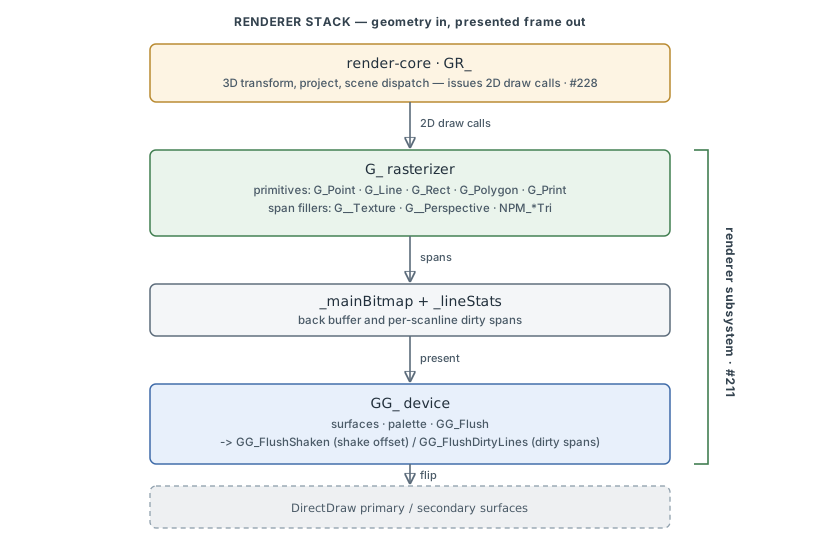
The renderer is a strict stack: the 3D core (render-core, GR_*) transforms geometry into
2D calls; the G_* rasterizer turns those into spans; the GG_* device presents the
finished frame to DirectDraw. This subsystem owns the lower two layers.
Functions¶
Representative subset of the device + rasterizer; the full record is in
db/symbols/renderer.csv.
| VA | Symbol | Role |
|---|---|---|
0x45DBD0 |
GG_InitMode |
create the DirectDraw surfaces and enter the graphics mode |
0x45DE70 |
GG_SetPalette |
upload the 192-entry palette to the primary surface |
0x45E120 |
GG_Flush |
present the back buffer (dispatches to the two paths below) |
0x45DEDF |
GG_FlushShaken |
present with the current screen-shake offset |
0x45E13F |
GG_FlushDirtyLines |
present only the dirty scanlines tracked in _lineStats |
0x45E3A0 |
GG_RestoreSurfaces |
rebuild surfaces after a DirectDraw device loss |
0x45CDA0 |
DrawAcrossBank |
span helper that draws across a VGA bank boundary |
0x497340 |
G_Init |
initialise the rasterizer (clip box, colour, font, line stats) |
0x4974F0 |
G_SetClipBox |
set the active clip rectangle |
0x4976D0 |
G_Point |
plot a single clipped pixel |
0x498160 |
G_Line |
draw a clipped line |
0x497BF0 |
G_Rect |
draw a clipped filled rectangle |
0x497DE0 |
G_ClipLine |
Cohen–Sutherland line clip against the clip box |
0x4986B0 |
G_Print |
draw a text string in the current font |
0x4B79B0 |
G_AllocBitmap |
allocate a rasterizer bitmap |
0x4B7CD0 |
G_LoadBitmap |
load a .PIC/brush into a bitmap |
0x4B7E10 |
G_RemapBitmapToPalette |
nearest-colour remap of a bitmap to _curPalette |
0x4B7FE0 |
G_Blit |
blit a bitmap to a surface |
0x4B8670 |
G_Scale |
scaled bitmap blit |
0x4B87F0 |
G_AcTexture |
affine-textured span setup |
0x4B9B90 |
NPM_TexturePerspectiveTri |
perspective-correct textured triangle rasterizer |
0x4C6ECC |
G_UPolygon |
unclipped convex-polygon span fill |
0x4C8A38 |
G_Polygon |
clipped convex-polygon span fill |
0x4CAE38 |
G__Texture |
affine texture-mapped scanline span filler |
0x4CBD0B |
G__Perspective |
perspective texture-mapped scanline span filler |
Open Questions¶
1. GG_Flush path selection¶
A disassembly + caller sweep corrects the premise. GG_Flush (0x45E120) is a single
SEH-wrapped flush routine — called by G_Flush (0x498420) and PlaySeq — that itself
chooses full-frame redraw (when _forceRedraw is set, or at 320×200) versus the
_lineStats dirty-line diff-blit default; its SEH handler is at 0x45E356. So the real
predicate is _forceRedraw/resolution inside GG_Flush, not a dispatch between two callees.
GG_FlushDirtyLines (0x45E13F) is a Ghidra mid-function split of GG_Flush's own body
(it falls inside the 0x45E120–0x45E356 extent), not a separate function; GG_FlushShaken
(0x45DEDF) is a distinct 518-byte variant with no direct callers in the image (reached, if
at all, only via a shake path outside the analyzed call graph). Both facts — the
GG_FlushDirtyLines fall-through split and the uncalled GG_FlushShaken — are now recorded in
the symbol-DB notes
(#262).
Status: resolved — re-static (single SEH flush; _forceRedraw/resolution predicate; DirtyLines is a Ghidra split).
Related¶
- reconstruction.md — the program this subsystem belongs to, and the forthcoming render-core (#228) 3D pipeline that drives this rasterizer.
- objects.md — the object system whose draw-enqueue passes feed geometry in.
- shape-selection.md / SH.md — the shape format the 3D core interprets into the polygon calls this rasterizer fills.
- formats/PIC.md — the bitmap format
G_LoadBitmapconsumes.