Memory & Resource Managers (MM / RM)
Two layers the whole engine loads assets through: MM, a handle-based memory allocator
with memory-mapped-file support (0x435C60–0x43631C), and RM, the resource manager — a
filename registry with an LRU cache that resolves per-type load hooks and pulls bytes from
LIB archives into MM handles (0x4A67F0–0x4A6E46).
Provenance: Ghidra static analysis of the game executable with FA.SMS symbols applied; recorded in the symbol database and applied to the Ghidra project. Progress: reconstruction matrix. Markers follow spec-authoring.md: confirmed · inferred · unknown.
MM — a 28-byte handle allocator
MM hands out T_HANDLE handles (28-byte free-list records) backed by VirtualAlloc/
GlobalAlloc, with alloc-id group free (free everything allocated under an id at once —
the pattern mission load uses to reclaim per-mission memory). Accessing a handle
(MMAccessR/MMAccessW/MMAccessE) is a pointer dereference (a no-op "lock" — a Mac-port
heritage), and flag 0x4000 marks a memory-mapped-file handle. MMFreeHandle calls back
into RM (RMNotify) to keep the resource registry coherent when a cached asset's memory is
released.
RM — filename registry + LRU cache + per-type hooks
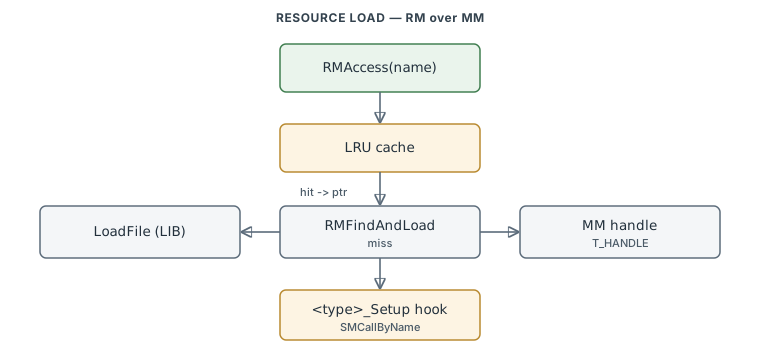
RM is a ~1400-slot filename registry (resList) with a 20-entry LRU cache. RMAccess by
name resolves through the cache; on a miss RMFindAndLoad pulls the bytes via LoadFile
(from a LIB) into an MM handle and runs the per-type hook — SMCallByName dispatches
<TYPE>_Load / _Setup / _Free (the same name-lookup mechanism the Chuck-Talk interpreter
uses). This is how a ~a10.SH reference in a .PT resolves to a loaded, engine-ready shape.
LIB name resolution — the hint index
Beneath RM sits the name→bytes layer. LoadFile (0x4AD3C0) uppercases the name and
resolves it in a fixed order: the LIB hint index first (DoLoadLibFile 0x479630 →
SearchLib 0x4798B0), then, on a miss, loose files on disk in extension-routed
subdirectories (shell, shapes, mission, types, ter_art, layer, …) via
LoadFile2 (0x4AD9B0). So an entry carried in a LIB always wins over a loose file of
the same name. LibFileExists (0x47A130) is the matching existence predicate: it calls
LibOpen (0x479BD0) to test LIB membership, then probes the same loose-file locations by
extension (FUN_0047A510). (This corrects an earlier label of 0x47A130 as an "MM text
keyword parser" — it is the resource manager's asset-existence test, invoked during MM load
among many other paths, not an MM-specific parser.)
The hint index is one flat namespace built at startup by LibStartUp (0x478BC0):
it enumerates the working directory with the glob *.* and, for each file, either opens it
and indexes its directory entries (names containing .LIB) or records the file itself as a
loose-file hint (type byte 0xFF). The result is a single array of 35-byte (0x23) records
in the hintHndl (0x4F7FC4) handle, counted by numHints (0x5473F0), kept sorted by
8.3 name so lookups are a bsearch (SearchLib, comparator CompareHintPtrs). The FA
TOOLKIT's CACHE/LIBPTR.* index (LIB.md) is not
consulted by the retail engine — no such strings exist in the executable; the engine
rebuilds the index itself on every run.
Duplicate-name precedence: the per-file hint inserter (0x47935E) reuses the existing
slot and overwrites it when SearchLib finds the name already present, so within the index
the last registration wins (registration order = directory-enumeration order). The
retail install sidesteps collisions in practice by partitioning content across archives
(the LIB.md inventory — each archive owns distinct
extensions/ranges). The two rules that always hold regardless of enumeration order:
LIB entries precede loose files, and within the LIB set a later mount overrides an
earlier one. Consumers that mount a whole install as one namespace (e.g. the fxs
workspace, gui.md) mirror this: LIB-before-loose, last-mounted-wins,
with every collision recorded rather than hidden.
Functions
Full record: db/symbols/memory-resource.csv.
| VA | Symbol | Role |
|---|---|---|
0x435C60 |
MMInit |
initialise the handle allocator |
0x4A6B30 |
RMFindAndLoad |
resolve + load + register a resource by name |
0x4A6AB0 |
RMCacheInsert |
insert into the LRU resource cache (evict oldest) |
0x4A6DF0 |
RMSetup |
post-load per-type hook (SMCallByName <type>_Setup) |
The LIB name-index layer (LoadFile 0x4AD3C0, LibStartUp 0x478BC0, SearchLib
0x4798B0, DoLoadLibFile 0x479630, LibFileExists 0x47A130) is documented in
prose above; those functions live in the executable's lzwlib unit and are not part of
this subsystem's symbol database.
Open Questions
1. FUN_004A6B10 ownership
FUN_004A6B10 (the ResolveTypeRecord helper) sits in the RM range but is owned by
objects.md — it resolves the MM handle at the type record's +0x0F. The
overlap is expected (RM and the object type-loader are tightly coupled); noted so the
boundary is explicit.
2. T_HANDLE flag bit 0x1000
Resolved statically (2026-07-05, #262):
0x1000 is the purged-handle mark from the allocator's Mac heritage (a purgeable
handle whose memory was discarded by compaction must be reloaded). The readers are
real and all follow the same recovery contract — RMFind (0x4A6990) drops a
registry entry whose entry flag +0x0E & 2 is set and whose handle carries 0x1000
(frees the husk, returns miss), RMFindAndLoad re-loads in a loop on the same test,
and BrushFromIndex (0x4AB860) / MAPDrawBG (0x4224EE) free-and-reload their
cached PIC handles. But the writer does not survive: MMUseHandle stores caller
flags verbatim and no call site passes 0x1000, MMFreeHandle zeroes the flag word,
and the one function that would purge — MMCompactRAM (0x4361B0) — is compiled to
return 0 on Win32. In the shipping game the flag can never be set; the recovery
paths are vestigial.
Status: resolved — vestigial purge protocol; writer stubbed out on Win32.
Related
- objects.md — the type-loader that resolves shapes through RM/MM.
- formats/LIB.md — the archive
LoadFilereads asset bytes from. - shape-selection.md —
RMAccessloads the shape variants.