Start Here
If you flew U.S. Navy Fighters, ATF, or Fighters Anthology in the 90s — and especially if you ever swapped a skin, edited a mission, or poked at the Pro editors — you already understand this game. What you're missing is the layer underneath: where each thing you remember actually lives on disk, what its bytes mean, and which part of the engine brings it to life. That's what this knowledge base documents, and this page is the map.
Everything here was recovered by reverse engineering and is validated by working code: for every format, the fx toolkit can decode and re-encode the real game files byte-identically — a round-trip is the proof that a spec is right, and the status matrix tracks exactly how far that proof extends for every format.
The 30-second map
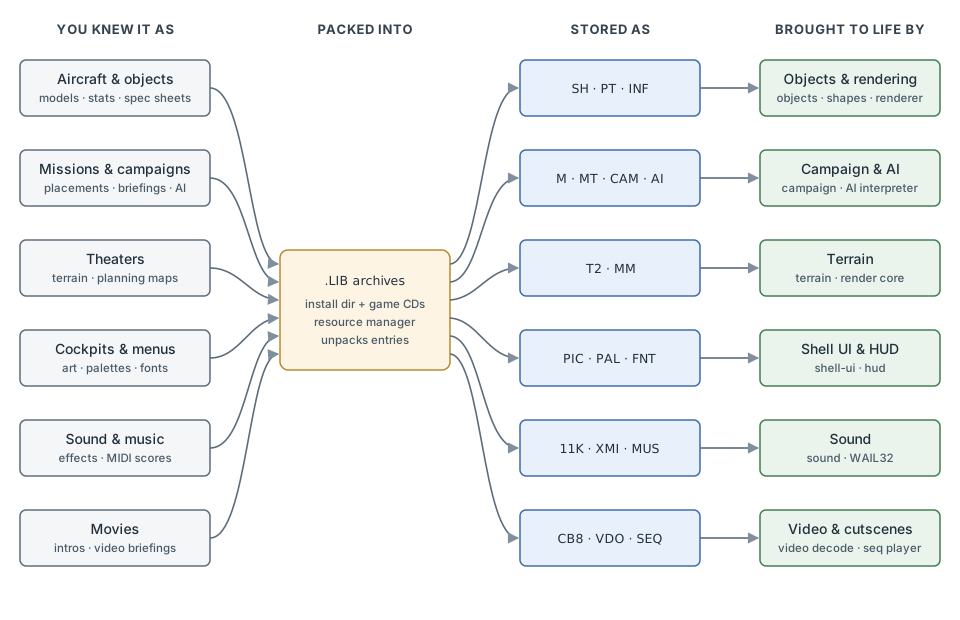
Almost every file the game owns is packed into a handful of .LIB archives (in the
install directory and on the CDs). The engine unpacks entries through its resource
manager and hands each format to the subsystem that consumes it. Modding, at its core,
has always been: unpack a LIB, change a file, put it back. The
LIB spec makes the container itself editable; the rest of the specs
make the contents editable.
What you already know, in file terms
| In the game | On disk | Start with |
|---|---|---|
| An aircraft's 3D model (and its damage states) | .SH shape |
SH |
| Its flight model, thrust, hardpoints | .PT |
PT |
| The reference-section spec sheet | .INF |
INF |
| A mission — placements, waypoints, triggers | .M |
M |
| Briefing and debrief text | .MT |
MT |
| A campaign | .CAM |
CAM |
| A theater — terrain and the planning map | .T2 + .MM |
T2, MM |
| Skins, cockpit art, menu screens | .PIC + .PAL |
PIC, PAL |
| Sound effects | .11K / .8K / .5K |
11K |
| Music | .XMI + .MUS |
XMI, MUS |
| Intro movies and video briefings | .CB8 / .VDO |
CB8, VDO |
| The Pro editors' object definitions | the BRF text DSL family |
BRF |
| Enemy behavior | .AI scripts (+ compiled .BI) |
AI, BI |
The full catalog — all formats, grouped the same way — is the format reference.
How the game is put together
Three layers, each documented at its own depth:
- The archives.
.LIBcontainers hold the assets; the architecture page explains the runtime environment, the resource manager, and how the game finds and prefers files (which is why dropping a modified LIB into the install directory works). - The executable. The engine is documented as named subsystems — the game loop dispatches objects, physics, the AI interpreter, weapons, the renderer, the HUD, and the rest. Every function and every referenced global in the executable has been named; each subsystem page gives you the recovered symbols, struct layouts, and a flow diagram.
- The overlay binaries. Audio (WAIL32), the serial/modem comms stack (comms), and the other companion binaries the game ships get the same treatment.
How to read a spec page
Format specs follow one template (spec-authoring.md), so once you can read one, you can read all of them:
- Front matter states the spec's completeness and which codec/tests validate it — claims are checked in CI, so what a page says matches what the tools do.
- Facts carry a confidence vocabulary — confirmed (proven by round-trip or engine disassembly) vs inferred (consistent with observations, not yet proven).
- File Layout is the byte-level truth; Engine Notes connect the format to the subsystem that consumes it; Open Questions are tracked as issues, not left to rot.
Pick your track
The modder. You want to change the game.
Read the modding guide first — step-by-step recipes with fx commands.
Then go deeper per asset type: LIB → PIC/PAL
for art, PT and the BRF family for stats and loadouts,
M/MT for missions. The status matrix
tells you which formats round-trip cleanly today.
The tool writer. You want to build your own extractor, converter, or editor. Start with LIB (everything else is inside it), then the format specs you care about; the CLI reference and C++ API show how the validation toolkit is put together, and spec-authoring.md defines the vocabulary the specs use. Fixture and fuzzing conventions are in development.md.
The engine archaeologist. You want to know how it works. Architecture → game loop → objects, then follow the subsystem pages wherever curiosity leads. The reconstruction matrix shows the naming/documentation state of every subsystem across all binaries; symbols, globals, and structs are the recovered-fact registries behind them.
Where the ground truth lives
Specs are prose, but the facts underneath are mechanical: recovered names and types live in the symbol database, codecs prove the formats, and CI regenerates and checks the matrices so the docs can't drift from reality. When a page says confirmed, something executable stands behind it.