VIEW — in-flight camera & replay
The VIEW subsystem (0x40D7A0–0x40F6B0) manages the in-flight camera — the external / spot
views, the slew (free-look) camera, view transitions, and the flight replay recorder — for
the main view struct _mainV. It was a gap in the original 19-subsystem map: FlyingLoop (see
game-loop.md) calls into it every frame, but only four functions carried FA.SMS
names (_VIEWSlew, _VIEWImmediateVisibility, _VIEWInTransition, _VIEWChangeObj) and the
15 helpers between them were unnamed. This page names them — the discovery filed as
#257, the same class of gap as the .SEQ
player (#240) and the SPX path (#241).
Provenance: Ghidra static analysis of the game executable with FA.SMS seed symbols; the
VIEW*helper names are recovered by this program from their behaviour. Confidence markers follow spec-authoring.md: confirmed · inferred.
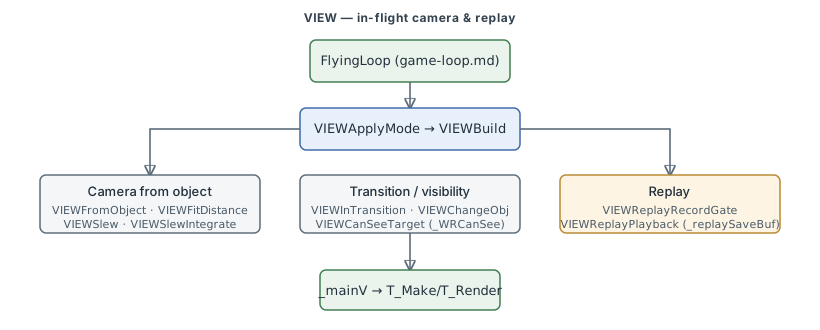
How it works
Each frame FlyingLoop calls VIEWApplyMode (0x40D7F0): when the view-mode word (_mainV[0x5A])
is set it delegates to the view builder VIEWBuild (0x40EBC0), which positions the
external / spot camera. The camera is derived from the tracked object — VIEWFromObject
(0x40D810) reads _objPtrs[_mainV[0x0E]], VIEWFitDistance (0x40E2C0) sets the stand-off
from the object radius, and the slew path (VIEWSlew + VIEWSlewIntegrate, frame-rate-scaled by
_systemFrameTicks) applies free-look. VIEWCanSeeTarget (0x40F5D0) is the padlock visibility
test (_WRCanSee), gated on a _gamePrefs bit.
The replay recorder is an in-memory record/playback pair over a single saved-view buffer —
it does not serialize to disk (#284).
VIEWReplayRecordGate (0x40E960) captures the live view into the 0x30-dword _replaySaveBuf
and interpolates the camera toward saved reference values (windowed _GRSinCos/_InterpAngle
blends) while _timerTicks is inside the capture window (_replayWindowStart/End), setting
_replayActive; VIEWReplayPlayback (0x40EBA0) copies _replaySaveBuf back into _mainV
on playback. The buffer (0x522400) is exactly one 0x30-dword (192-byte) view-state block —
it abuts _replayActive at 0x5224C0 — written and read only by this pair, both called only
from FlyingLoop; there is no growing/ring buffer, no file I/O on the path, and the executable
contains no replay/demo file strings. So the "replay" is a momentary in-RAM camera snapshot and
blend-back, not a mission recording, and there is no on-disk replay format to specify.
Functions
| VA | Function | Role |
|---|---|---|
0x0040D7A0 |
VIEWSlew |
slew (free-look) camera control |
0x0040D7F0 |
VIEWApplyMode |
dispatch to VIEWBuild when the view mode is set |
0x0040D810 |
VIEWFromObject |
position the camera from the tracked object |
0x0040E2C0 |
VIEWFitDistance |
camera stand-off from object radius |
0x0040E380 |
VIEWImmediateVisibility |
force immediate (no-transition) visibility |
0x0040E3A0 |
VIEWInit |
allocate / initialise a view slot |
0x0040E450 |
VIEWFree |
free the view's buffer |
0x0040E930 |
VIEWInTransition |
non-zero while the view is mid-transition |
0x0040E960 |
VIEWReplayRecordGate |
set _replayActive inside the capture window |
0x0040EBA0 |
VIEWReplayPlayback |
copy _replaySaveBuf back into the view |
0x0040EBC0 |
VIEWBuild |
build the external / spot view |
0x0040F2D0 |
VIEWSlewIntegrate |
frame-rate-scaled slew integration |
0x0040F590 |
VIEWChangeObj |
switch the view to a different tracked object |
0x0040F5D0 |
VIEWCanSeeTarget |
padlock visibility test (_WRCanSee) |
Open Questions
1. View-mode enumeration
_mainV[0x5A] selects the view mode that VIEWApplyMode dispatches on, and VIEWModeLookup
(0x40F230) scans the _viewModeTable (0x4EC420); the exact mode enumeration (cockpit / spot /
padlock / fly-by / external) is not fully pinned. A short trace of the callers that write
_mainV[0x5A] would settle it.
Status: open — re-static (#262).
Related
- game-loop.md —
FlyingLoop, which drives VIEW each frame. - renderer.md / render-core.md —
T_Make/T_Render, which draw_mainV. - objects.md — the tracked-object system the camera follows.