Object / Entity System
How the game executable stores, services, and dispatches behavior for every live game object — aircraft, ground vehicles, projectiles, and static props alike. This is the runtime spine the flight model, AI, weapons, and renderer all hang off: one object chain walked every frame, a current-object mirror each handler operates on, and a proc-dispatch indirection that routes events, damage, and updates to the right per-class code.
Provenance: Ghidra static analysis of the game executable with FA.SMS symbols applied; recovered from
DumpAllFunctions.txtandAnalyzeOTNT.txt(scripts/ghidra/). Every symbol here is recorded in the symbol database and applied to the Ghidra project; progress is tracked in the reconstruction matrix. Confidence markers follow spec-authoring.md: confirmed · inferred · unknown.
Objects, ids, and the pointer table
Every object is a variable-length record addressed by a small integer id. The
global pointer table _objPtrs (0x553848) maps id → record base; almost all
engine code reaches an object as (&_objPtrs)[id]. Id 0 is the null object. Ids
are handed out by the allocator (below); a separate high band of alias ids
(negative, per-computer) is reserved for multiplayer references.
The first bytes of every record are shared across all classes — the fields the object system itself reads:
| Offset | Size | Field | Meaning | Confidence |
|---|---|---|---|---|
+0x00 |
1 | class |
object class tag (& 0x1f); 4 = aircraft |
confirmed |
+0x01 |
4 | flags |
status bits; & 1 = alive, & 0x100000 = draw destroyed model |
confirmed |
+0x05 |
4 | type |
pointer to the shared type record (OT/NT/PT/JT) | confirmed |
+0x0E |
2 | health |
0 = destroyed |
confirmed |
+0x11 |
12 | pos |
world position (X,Y,Z, 24.8 fixed) | confirmed |
+0x64 |
2 | next_id |
next object in its service chain | confirmed |
+0x68 |
2 | service_key |
sort key that orders the service chain | inferred |
+0x6C |
4 | event_override |
optional per-instance proc override | inferred |
The per-instance record is documented in full in structs.md; the shared type record (and its shape fields) in shape-selection.md.
The current-object mirror (_cg / _cgt)
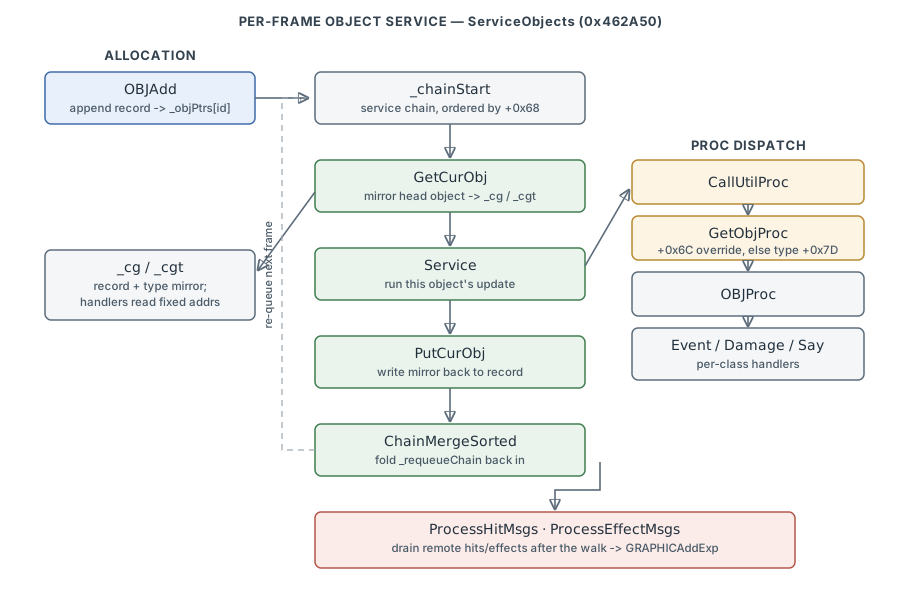
Handlers do not operate on the object record in place. GetCurObj (0x4628B0)
copies the whole record into a fixed scratch buffer _cg (0x50CE80) and its type
record into _cgt (0x50D268), records the id in _curId (0x4F6FBC), and (for
aircraft) unpacks the flight-model fields. Every subsystem then reads and writes
_cg/_cgt — which is why so much of the engine references fixed addresses like
_cg+0x11 (position) rather than an object pointer. PutCurObj (0x462980) copies
the mirror back and clears _curId. _curObjSize/_curTypeSize hold the byte
counts to copy; PushCurObj/PopCurObj nest the mirror (_curObjStackTop) so a
handler can service a second object re-entrantly.
This mirror is the reason the object record layout and the _cg global layout are
the same map — a fact this subsystem's waivers record explicitly, pointing every
_cg+N interior back to entity +N in structs.md.
The service chain and per-frame loop
Active objects live on a singly linked service chain (_chainStart, 0x546B90),
ordered by service_key (+0x68). ServiceObjects (0x462A50) walks it once per
frame:
GetCurObjmirrors the head object.- If its ready time is in the future, stop (the chain is time-ordered).
- Detach the head, run its update via
Service→ the proc dispatch below. - If the handler destroyed the object and the type opts into auto-removal
(
type +0x09 & 0x400),RemoveCurObjunlinks it. PutCurObjwrites the mirror back, then the object is re-queued.
Servicing pulls objects off _chainStart and collects the ones to run again into a
re-queue chain (_requeueChain, 0x546BA8); ChainMergeSorted (0x462B70)
folds that back into _chainStart in service_key order at end of frame.
ChainInsertCurObj (0x4626D0) does the ordered insert; ChainRemoveCurObj
(0x462640) the unlink. After the walk, ServiceObjects drains two remote-event
queues (below).
Proc dispatch — one object, many behaviors
An object's behavior is not called directly; it is resolved through a proc
selector. CallUtilProc (0x463F60) is the hub: given a selector index it calls
GetObjProc (0x463F30), which returns either the object's per-instance override
(+0x6C) or the class proc looked up on the type record (+0x7D), then invokes it.
Higher-level entry points wrap it:
CallEventProc(0x4639C0) — routes a game event, first offering it to a global_eventFilterProchook (used by the mission/AI layer to intercept).CallDamageProc(0x463EC0) — routes a hit; may triggerRemoveCurObjwhen the object dies and the type auto-removes.
Each object class publishes its procs through a small selector function.
OBJProc (0x473BE0) is the static-object one: selector 3 → OBJEventProc
(0x473A40), 4 → OBJDamageProc (0x473B40), 6 → OBJSayProc. Aircraft,
projectiles, and ground vehicles (GV) publish their own proc sets the same way, so
the same CallUtilProc call reaches class-appropriate code.
Allocation and aliases
Objects are bump-allocated from a single arena. OBJInit (0x491250) reserves the
arena (_objArena, capacity _objArenaSize) and seeds the id counter and the
per-computer alias band (_tempAliasBase/_tempAliasMax). OBJAdd (0x4913E0)
copies a prepared record to the arena bump cursor (_objArenaNext), records its byte
size in _objSizes, and publishes the id → base entry in _objPtrs; OBJSubtract
(0x491490) pops the most recent one. OBJAlias (0x4914C0) and its variants map a
transient reference (waypoint, multiplayer peer, preferred target) onto a real id so
that AI and networking can name objects that may not be locally resident.
Remote effect and hit queues
In multiplayer, other computers' hits and effects arrive as messages, drained after the service walk:
ProcessHitMsgs(0x462C91) — reads hit events (MSG 0x800B/0x800C), raises the0x4000event on the target, and spawns the explosion viaGRAPHICAddExp.ProcessEffectMsgs(0x462D40) — reads per-computer effect spawns (MSG 0x8003+n): explosions, smoke trails, andMANAddman/parachute spawns.
Local destruction takes the same visual path from the flight model:
PLANEBreakUp sets the 0x300000 destroyed/awaiting-swap flags and writes the
damage-set selector — see shape-selection.md.
GRAPHIC effect spawning
Transient visual effects — explosions, smoke, fire, debris, craters, chaff/flare, dust
puffs — are not full game objects. They live in a fixed GRAPHIC pool: a 100-entry
array _graphics of 0x66 (102)-byte entries, initialised by _GRAPHICInit@0
(0x442c00), stepped every frame by _GRAPHICUpdate@0 (0x442de0), and drawn by
_GRAPHICAddYourObjs@4 (0x4431b0) when the object system's 0x200 "add graphics" flag
is set. A free entry is marked by 0xffff in the owner field (+0x04); the allocator
FUN_00443b70 linear-scans for a free slot, or when full evicts the effect with the
lowest priority-weighted age (older + lower-class effects go first).
Spawn API
Every spawner takes a spawning-computer id as its first argument (network origin —
the local machine only mirrors the spawn to peers when it equals _thisComputer, via the
MP* twin) and an F24_POINT3* world position. The family:
| VA | Function | Parameters after (computerId, pos) |
|---|---|---|
0x4432d0 |
_GRAPHICAddExp@28 |
ownerObjIdx, useOwnerVelocity, spawnSecondaryDebris, collisionScatter — the canonical explosion; applies random type-variation (see below) and chains debris / cluster-release / smoke children |
0x443e80 |
_GRAPHICAddSmoke@28 |
type, lifetime, riseHeight, intensity2, ownerObjIdx — a smoke puff that drifts with _windH/_windSpeed |
0x444020 |
_GRAPHICAddFire@32 |
type, ownerObjIdx, WORD_POINT3* mountOri, groundZ, intensity, intensity2 — attaches a looping fire + sound |
0x4441d0 |
_GRAPHICAddDebris@24 |
count, WORD_POINT3* baseVel, spread, upwardBias — scatters count tumbling fragments |
0x443d00 / 0x443dc0 |
@GRAPHICAddCrater@12 / @GRAPHICAddHulk@12 |
id — ground scar / burnt-out hulk marker |
0x443f90 / 0x4443d0 / 0x444560 |
_GRAPHICAddSmokeAdder@40 / _GRAPHICAddClusterRelease@24 / _GRAPHICAddSpecialDebris@16 |
secondary-spawn helpers used by AddExp |
0x4447a0 |
@GRAPHICAddDevice@12 |
type, WORD_POINT3* ejectDir — countermeasure dispense (type 0xC = CHAFF, 0xD = FLARE) |
0x444150 |
_GRAPHICMakeAdder@24 |
entry*, adderType, interval, p1, p2, p3 — converts an existing entry into a continuous emitter (below) |
The MP twins carry the fully-typed signatures that pin the parameter kinds, e.g.
?MPGraphicAddExp@@YGXJPAUF24_POINT3@@GDDD@Z (id J, F24_POINT3*, owner G, three
flag bytes D) and ?MPGraphicAddFire@@…GPAUWORD_POINT3@@JJJ@Z (a WORD_POINT3*
orientation plus three longs).
GRAPHIC entry layout (0x66 bytes)
| Offset | Size | Field | Meaning |
|---|---|---|---|
0x00 |
u8 | type |
effect type → shape and parameter tables (below) |
0x01 |
u8 | frame |
shape frame / colour variant |
0x02 |
u16 | flags |
bit0 attached-to-owner · bit1 terrain-follow · bit5/6 fuse-timing mode · bit7 expired · bit8 emitter (has adder) |
0x04 |
u16 | owner |
owner object index into _objPtrs; 0xffff = free slot |
0x06,0x0A,0x0E |
F24×3 | pos |
world position (F24.8) |
0x12,0x14,0x16 |
s16×3 | orient |
orientation, spun each frame by the rates at 0x3A |
0x18 |
F24 | ground_z |
terrain floor from _T_Info — the Z the effect settles onto |
0x1C,0x1E,0x20 |
s16×3 | mount |
attach offset applied via _RotatedOffset when flags bit0 is set |
0x22,0x26,0x2A |
F24×3 | vel |
velocity, integrated by _frameTicks each update |
0x2E,0x30,0x32 |
s16×3 | accel |
drift/acceleration (smoke seeds this from wind) |
0x34,0x36,0x38 |
s16×3 | damp |
velocity damping targets (_MatchF24) |
0x3A,0x3C,0x3E |
s16×3 | spin |
per-axis angular rate |
0x40 |
i32 | spawn_tick |
_currentTicks at spawn |
0x44 |
i32 | expiry_tick |
death tick (lifetime*0x100 + spawn; 0x7FFFFFFF = permanent, e.g. craters) |
0x48 |
u8 | intensity |
brightness / scale |
0x49 |
u8 | intensity2 |
secondary brightness / alpha |
0x4A |
u8 | adder_type |
continuous-emitter type (0 = none; 7–11 = smoke trail) |
0x4B |
u16 | adder_interval |
ticks between child spawns |
0x4D–0x4F |
u8×3 | adder_p1..3 |
child-spawn parameters |
0x50 |
i32 | adder_next |
next emit tick |
0x54 |
char[] | loop_sound |
looping sound-effect name (fire) |
0x61 |
u16 | sound_param |
loop-sound parameter |
0x65 |
u8 | spawn_computer |
network origin computer id |
Effect types and shapes
_GRAPHICInit@0 resolves one .SH handle per effect type into a table at _DAT_0053da38
(indexed type*4). The type ranges:
| Type(s) | Shape | Effect |
|---|---|---|
0 |
— | none / mixed |
1–3 |
crater.SH |
ground craters |
4–6 |
debris.SH |
tumbling debris |
7–11 |
smoke.SH |
smoke puffs / trails |
12 |
chaff.SH |
chaff bundle |
13 |
flare.SH |
flare |
14 |
fire.SH |
fire |
15–0x26 |
exp.SH |
explosion variants (airbursts, ground bursts, water, etc.) |
0x28–0x2A |
spd/mpd/lpd.SH |
small / medium / large dust puffs |
For a local AddExp, the requested type is randomly varied into a nearby variant
(_Percent_4/_Rand_4) so repeated explosions differ — e.g. type 0x12 promotes to one
of 0x13/0x14/0x1C/0x1D a fraction of the time. The random remap runs only on the
originating machine; the chosen concrete type is what ships in the network mirror, so all
peers show the same variant.
Effect-parameter table
The static per-type tuning lives in a 0x30 (48)-byte record indexed by effect type at
0x4f46c4 (AddExp reads it as base + type*0x30). Recovered fields:
| Offset | Size | Meaning |
|---|---|---|
0x04 |
s16 | intensity base (scaled by Rand(0x42)+0x42 → entry 0x48/0x49) |
0x06 |
s16 | shape frame count / start frame |
0x08 |
u16 | sub-type / shape selector (low byte also carries a ground-burst flag, bit 2) |
0x0A |
s16 | secondary-debris count |
0x0C |
s16 | secondary-debris spread |
0x0E.. |
u32[≤8] | sound-effect name pointers — one picked at random per spawn (list ends at first null) |
0x2E |
s16 | sound pitch/parameter |
This record is the effect-data block that the fx_lib effect interpreter
(#315) turns into semantic form; the
remaining bytes of the 0x30 record are not yet individually resolved.
Adders (continuous emitters) and lifecycle
_GRAPHICMakeAdder@24 sets flags bit8 and fills 0x4A–0x50, turning an entry into a
periodic emitter. Each _GRAPHICUpdate@0 tick, FUN_00442e10 computes the entry's life
fraction (now − spawn_tick)·100 / (expiry_tick − spawn_tick); when it crosses the
fuse threshold (100% for bit6, 50% for bit5) it spawns its follow-on (e.g. a burning wreck
grows a fire + smoke adder), and while alive an adder of type 7–11 emits a smoke child
every adder_interval ticks. Non-attached entries integrate velocity and spin; attached
entries (bit0) track their owner via _RotatedOffset from the mount offset. When
now ≥ expiry_tick the entry is freed (owner = 0xffff).
Effect spawns propagate to other machines as MSG 0x8003 records (17 bytes:
type u8, pos F24×3, owner u16, two flag bytes), drained remotely by
ProcessEffectMsgs (above).
Globals
Recovered object-system state (full list, with per-symbol confidence, in the symbol database):
| Global | Address | Role | Confidence |
|---|---|---|---|
_objPtrs |
0x553848 |
id → record base pointer table |
confirmed |
_chainStart |
0x546B90 |
head of the service chain | confirmed |
_requeueChain |
0x546BA8 |
objects to re-queue this frame | confirmed |
_curId |
0x4F6FBC |
id of the mirrored current object | confirmed |
_cg |
0x50CE80 |
current-object record mirror | confirmed |
_cgt |
0x50D268 |
current-object type-record mirror | confirmed |
_curObjSize |
0x546B94 |
bytes to copy for the object mirror | confirmed |
_curTypeSize |
0x546B9C |
bytes to copy for the type mirror | confirmed |
_objArena |
0x4FFE34 |
base of the entity arena | confirmed |
_objArenaNext |
0x553828 |
arena bump cursor | confirmed |
_objArenaSize |
0x553840 |
arena capacity, bounds OBJAdd |
confirmed |
_objSizes |
0x553120 |
per-id record byte sizes | confirmed |
_nextObjId |
0x553838 |
next id to allocate | confirmed |
_tempAliasNext |
0x55383C |
next transient alias id | confirmed |
Functions
| VA | Symbol | Role |
|---|---|---|
0x00462600 |
InitChain |
reset the service chain and event hook |
0x00462A50 |
ServiceObjects |
per-frame walk of the object chain |
0x004626D0 |
ChainInsertCurObj |
ordered insert by service_key |
0x00462640 |
ChainRemoveCurObj |
unlink the current object from a chain |
0x00462B70 |
ChainMergeSorted |
fold the re-queue chain back into _chainStart |
0x004628B0 |
GetCurObj |
copy an object + type into the _cg/_cgt mirror |
0x00462980 |
PutCurObj |
write the mirror back to the record |
0x00463F60 |
CallUtilProc |
resolve and call a proc by selector |
0x00463F30 |
GetObjProc |
pick instance override (+0x6C) or class proc (+0x7D) |
0x004639C0 |
CallEventProc |
route a game event (through _eventFilterProc) |
0x00463EC0 |
CallDamageProc |
route a hit; may auto-remove on death |
0x00473BE0 |
OBJProc |
static-object proc selector |
0x00473A40 |
OBJEventProc |
static-object event handler |
0x00473B40 |
OBJDamageProc |
static-object damage handler |
0x00491250 |
OBJInit |
reserve the entity arena and id/alias bands |
0x004913E0 |
OBJAdd |
append a record; publish id → base |
0x00491490 |
OBJSubtract |
pop the most recently added record |
0x004914C0 |
OBJAlias |
map a transient reference onto a real id |
0x00462C91 |
ProcessHitMsgs |
drain remote hit events → explosions |
0x00462D40 |
ProcessEffectMsgs |
drain remote effect spawns |
0x00436B30 |
MoveObj |
advance an object toward its move goals |
0x004A6EB0 |
SetupOT |
type-load: generate damage-model variants (see shape-selection) |
0x00442C00 |
GRAPHICInit |
init the 100-entry effect pool + per-type .SH handles |
0x00442DE0 |
GRAPHICUpdate |
step every live effect (motion, fuse, adders) |
0x004431B0 |
GRAPHICAddYourObjs |
draw live effects when the object 0x200 flag is set |
0x004432D0 |
GRAPHICAddExp |
spawn an explosion (+ chained debris / smoke) |
Open questions
1. service_key (+0x68) time base — resolved
+0x68 (a u16) is an absolute schedule tick on the mission-sim clock (_currentT),
not a relative offset. The service walk gates on it directly against the clock — objects are
processed while key <= deadline and skipped while _currentT + 1 < key ((&_objPtrs)[id] +
0x68) — so the chain is a priority queue keyed by absolute due-time. The re-queue writes the
next key through TimeAddSat (0x463B90), which saturates near 0x7FFF instead of
wrapping (the same guard applied to DAT_0050CED2/CED4), matching _currentT's 0x7F9A
cap. So an object due "now + N ticks" stores TimeAddSat(_currentT + N), and near end-of-scale
the key sticks at 0x7FFF rather than wrapping past the clock.
Status: resolved — re-static.
Related
- shape-selection.md — the whole-model damage swap and the type-record shape fields this system's objects carry.
- structs.md — the full per-instance entity record mirrored into
_cg. - game-loop.md — where
ServiceObjectssits in the per-frame update. - physics.md — the flight model that runs inside an aircraft's service
slot and drives
PLANEBreakUp. - network.md — the multiplayer layer that produces the remote hit and effect messages, and consumes object aliases.