.SEQ Cutscene Player
The .SEQ sequence player runs Jane's scripted intro/outro cutscenes from a text
script file (e.g. g_intro). It loads and compiles the script, then ticks a timeline of
commands that draw bitmaps, blocks and wrapped text into a display list, fade the palette,
and play music, sound and video. 0x444F70–0x4471E0 (plus the public entry PlaySeq at
0x412C10).
Provenance: Ghidra static analysis of the game executable with FA.SMS symbols applied; recorded in the symbol database and applied to the Ghidra project. Progress: reconstruction matrix. Markers follow spec-authoring.md: confirmed · inferred · unknown. Found by the reproducibility audit as the 19th subsystem the original map missed (#240).
Dispatch is by name, not by opcode
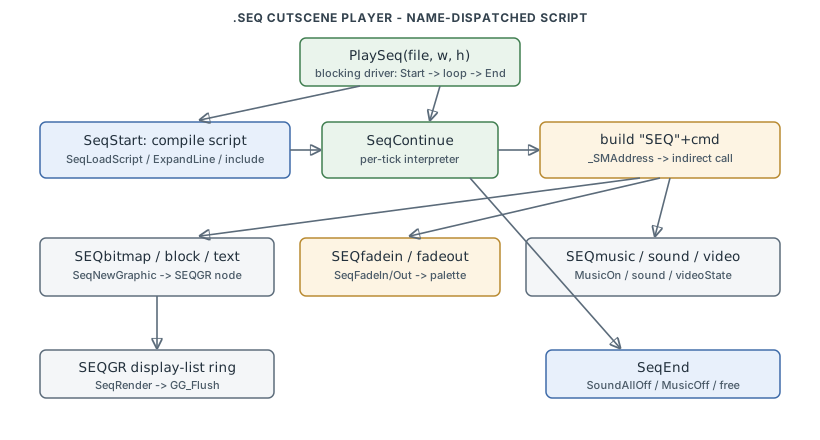
The defining feature of the .SEQ player is that script commands are dispatched by
name through the shipped symbol table, not through a switch or an opcode jump table.
_SeqStart reads the .SEQ file, performs %N argument substitution and include
expansion (SeqLoadScript → SeqExpandLine / SeqParseInclude), and compiles the result
into a per-slot command buffer. Each tick, _SeqContinue fetches the next line
(SeqFetchLine parses a leading /abs or +rel timecode), then for a command word like
bitmap it builds the string "SEQ" + command into a local buffer, resolves that
symbol at runtime with _SMAddress (a lookup into the same FA.SMS map this project
applies), and indirect-calls it with up to eight parsed operands.
The consequence for reconstruction is concrete: the twelve _SEQ<verb> handlers
(_SEQbitmap, _SEQtext, _SEQmusic, _SEQvideo, _SEQwait, …) are reached only
through _SMAddress, never by a direct CALL, so Ghidra's auto-analysis never created
them as functions. They exist in the binary — FA.SMS gives their addresses — and applying
the symbol database materialises them (createFunction). This is exactly the class of
name-dispatched leaf that a purely xref-driven inventory misses.
Graphics: the SEQGR display list
Drawing commands do not paint immediately; they allocate SEQGR nodes from a
free-list (SeqNewGraphic) and link them into a ring (seqGraphics). Each node carries a
rect, a type (1 = bitmap, 2 = filled block, 4 = multiline colour text), an owning-sequence
index and an expiry tick. SeqRender walks the ring once per frame, expires aged nodes
(SeqExpireGraphics), and redraws the dirty ones under the current clip box
(SeqDrawGraphic), marking overlapped neighbours dirty so partial refreshes stay correct.
Palette fades run in parallel: _SEQfadein / _SEQfadeout latch a direction into
seqFading, and SeqFadeIn / SeqFadeOut blacken or restore curPalette by an
elapsed/length ratio each tick.
Functions
Full record: db/symbols/seq.csv.
| VA | Symbol | Role |
|---|---|---|
0x412C10 |
PlaySeq |
public entry — blocking SeqStart → tick loop → SeqEnd |
0x445060 |
SeqStart |
load .SEQ, alloc a SEQUENCE slot, compile the script |
0x445330 |
SeqLoadScript |
read the file, expand includes and %N substitutions |
0x445700 |
SeqContinue |
per-tick interpreter — build "SEQ"+cmd, _SMAddress-dispatch |
0x446500 |
SeqNewGraphic |
allocate a SEQGR node and link it into seqGraphics |
0x445ED0 |
SeqRender |
walk the display-list ring, expire + redraw dirty nodes |
0x446660 |
SEQbitmap |
script op — display a bitmap as a SEQGR node |
0x446F10 |
SEQtext |
script op — wrapped-text node via FormatText |
0x446B70 |
SEQmusic |
script op — start a music track (MusicOn) |
0x445E30 |
SeqEnd |
tear down all sequences — SoundAllOff / MusicOff / free |
Open Questions
1. Dispatch prefix and keyword strings — resolved
A direct read of the .data bytes settles them:
| VA | Bytes (C string) | Role |
|---|---|---|
0x004F4F5C |
"_SEQ" |
the dispatch prefix — SeqContinue builds "_SEQ" + cmd and resolves it through _SMAddress, matching the _SEQ<verb> handler names |
0x004F4F64 |
"sync" |
the sync script keyword |
0x004F4F6C |
".XMI" |
the music-file extension, not a SEQmusic suffix — the _SEQmusic op loads an .XMI sequence ("all" follows at 0x004F4F74) |
So the prefix is "_SEQ" (with the leading underscore, hence the _SEQ<verb> labels), and the
third string is the .XMI extension the music op appends — the earlier SEQmusic guess was
wrong. (Read via the PE .data section; these sit at file offset 0x… in the 0x4EB000-based
.data block.)
Status: resolved — re-static ("_SEQ" / "sync" / ".XMI").
2. SEQUENCE / SEQGR struct maps — resolved
The program-wide struct-typing pass (#230)
addressed this: SEQUENCE (stride 0x38), SEQGR, SEQLBL, SEQFNT and SEQTXT are declared
as the recovered type vocabulary in db/types/fa_types.h,
and the FA.SMS array-base globals are typed against them (seqGrArray/seqGrList/seqGraphics
→ SEQGR *, seqFontArray/seqFonts → SEQFNT *, seqTextArray → SEQTXT *,
seqLabelList → SEQLBL *). Per that pass's conservative policy the struct interiors stay
reserved padding rather than guessed byte-exact layouts.
Status: resolved — struct-typing pass (#230).
Related
- sound.md —
MusicOn/SoundAllOff, driven by theSEQmusic/SEQsoundops. - video-decode.md — the Cobra
.VDOplayer theSEQvideoop invokes. - renderer.md —
GG_Flushand the bitmap blit theSEQGRrenderer uses. - formats/SMS.md — the FA.SMS symbol map that
_SMAddress(0x46A4E0) resolves the"SEQ"+cmdnames against.