Skip to content

Shell / Menu / Dialog UI

The out-of-cockpit interface: the menu-bar state machine and the dialog/widget core, the text/format engine (a dot-directive markup language shared by briefings, reference pages, and the pilot dossier), the name-list machinery behind every file picker, the Jane's reference (INFO2*) screens, and the in-flight menu (FlightMenu).

Provenance: Ghidra static analysis of the game executable with FA.SMS symbols applied; recorded in the symbol database and applied to the Ghidra project. Progress: reconstruction matrix. Markers follow spec-authoring.md: confirmed · inferred · unknown.

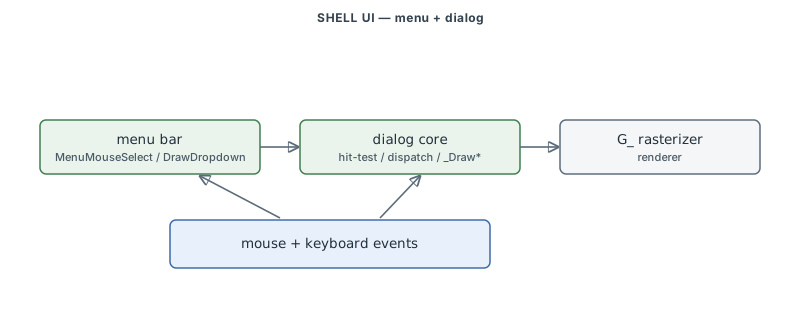
  • Menu core (0x40B8A0–0x40D79C): the menu-bar state machine — MenuStartUp, MenuLoadFont (MENUFONT.PIC / MFONT320.PIC), MenuMouseSelect (hit-test), and MenuDrawDropdown (draw an opened submenu with background save/restore), over a _firstMenu linked list with palette-remap chrome.
  • Dialog/widget core (0x487A3A–0x48D200): the DIALOG lifecycle — record hit-test and dispatch, and every _Draw* widget renderer (check/toggle/list-box/scrollbar) with edit/rocker/slider input. Many _Draw* handlers are label-only in FA.SMS and materialise on apply.
  • Shell chrome (#492): ShellSetup loads the mouse-pointer PIC (MOUSE320/MOUSEPTR by resolution), the drop-shadow PIC set (SHADV32/SHADV64 + corner pieces), and — for the in-flight menu — a steel background pattern and its palette band; ShellOff / MenuShutDown restore the saved background and palettes and free the chrome. MainMenu services the shell menu bar (Alt+F4 → exit; menu group 2 → CampaignMenu), and DialogDrawBkgd blits a named .PIC as a full-screen dialog backdrop. confirmed

Shell UI: the menu-bar state machine and the dialog record hit-test/dispatch loop, each drawing through the rasterizer.

The text/format engine (#492)

0x47D190–0x47F660 is a self-contained rich-text engine. PrepareText(text, len, section, style, x, y, w, h, …) paginates a marked-up buffer into 0x18-byte page records (font, indent state, text cursor per page); PrintText(page) replays one page; PageText, FreeTextStuff (pop one nested context; up to four contexts stack at _fmtText), FormatInit, and EndText manage the lifecycle. Fonts load by index through a TITLEFONT.PIC-rooted name table with cached handles (FormatLoadFont); glyph metrics come from a 6-byte-per-glyph table at font-PIC +0x2A (width +2, height +4FontGlyphSize). confirmed

The directive language. FormatToken (0x47D700) walks the text one whitespace token at a time; dot-directives dispatch to FormatDirective (0x47E1B0) — the exact compare chain the MT spec's directive table was read from (.section, .page, .title/.header/.body, .italic/.bold/.underline with .. off forms, .left/.right/.center/.full, .indent_*, .picture, .sound, .music/ .music_off, .button/.dbutton → hit boxes in _buttonBoxes/InTextButton) — and plain words are measured, word-wrapped, and rendered. FindSection/FindSectionHeader locate .section <n> entry points. confirmed

The one engine renders the .MT briefing texts, the reference .INF pages, SHWPILOT.TXT (the pilot dossier template), the .CAM campaign descriptions (<name>.TXT), and inline UI strings (PilotScreen lays out its Prev/Next strip as a .button string). AddStats composes the whole debrief — CAMPAIGN / MISSION AVERAGES / PLAYER WINGMAN / AIRBASE sections with kills, losses, damage, landing grade — as directive-marked text into this engine. _GetString (modal edit dialog) and ClipString (ellipsized print) round out the text utilities. confirmed

Name lists (#492)

GetNames(mask) (0x41C840) builds the list behind every picker: category bits select directory globs — types\*.PT/.NT/.OT/.JT, mission\*.M, *.T2 (theaters), *.2D, *.P (pilots), *.COM (with the DOS sound drivers SOUNDRV/MIDPAK/CMIDPAK/ RMIDPAK excluded) — into 0x30-byte NAMES records {u32 class/flags, char[13] filename, char[30] title}. Titles come from the mission-file header or the type record; type entries carry the class byte, the user-flyable flag (type +9 bit 0x4000), and an era filter on the type-record year at +0x37 (the reference screen's era categories, e.g. 1955–1976). NamesSort/NamesDedupe (quicksort by title + adjacent-filename compaction), MakeNamesForList (NUL-separated buffer for the DLG list widget), and DialogPickFiles (the generic "Choose an object/mission/map" picker into _itemPicked) sit on top. confirmed

The Jane's reference screens (INFO2*, #492)

INFO2Screen (0x461710) is the aircraft/weapons encyclopaedia: ar_menu + ar_dlg over an ar background, a day1.LAY weather context for the 3-D pane, and GetNames category filters on the Reference menu. INFO2SetType selects an item — loading its type record, sizing the 3-D view from ObjRadius × 15, probing <type>_0…8 photo pages, and enabling the media buttons. INFO2Draw renders the pane by mode: confirmed

  • Text — the type's .INF file through the format engine, paginated.
  • 3-D view — a two-entry display list (horizon + shape) rendered by GRRender with the shape's own palette band, a v_air/v_land/v_sea backdrop chosen from the type's basing flags, arrow-key/mouse-drag rotation (5°/step) and +/− zoom. The four carriers (nimz/wasp/kitt/clem.NT) substitute extended display shapes (x<name>.SH). With the 3-D-glasses pref (gamePrefs bit 0x20000000) it renders a stereo pair offset by ±_glassesXDiff and interleaves the halves (GLASSES*).
  • Photos/art<type>_<n>.PIC pages plus fixed _p/_c/_e/_f art, with ar_nopic as the fallback and PAGE n OF m overlay.
  • Video — three per-type videos (ar_vidp/ar_vidh/ar_vidm stills when present) played through the Cobra player (PlayCobra; see video-decode.md).

The Fly button (flyable types, or ASTOVL) writes _missionName = ~a<type>.M (non-flyable: ~info.M) and _selectedTypeName, then returns 1 — the shell launches a generated quick mission. The ~ filename prefix marks such engine-generated missions (~fake.M, ~info.M — the corpus-prefix question from the asset audit). confirmed

FlightMenu — the in-flight menu (#492)

FlightMenu (0x474800) pauses the sim (_timeCompression = 0x7FFF) and presents the FMENUD menu; every item maps onto engine state, which makes it the index of the preference bits: confirmed

  • Control (group 0x200): _stickDevice 0–6 / _rudderDevice 7–8 / _throttleDevice 9–10 (the device-proc table), each followed by InputCalibrate; coolie-hat mode (gameMultiPrefs bit 0x800: view slew vs thrust vector).
  • Sim (group 0x300): time compression (paused 0x7FFF; −1, 0…3 as shift counts = 1/2x, 1x-8x; capped at 1× in multiplayer), GraphicPrefs/SoundPrefs dialogs, HUD brightness, cockpit style (gamePrefs bit 0x800000, rebuilds via CPShutdown/ CPInit), realistic avionics (bit 0x2000000), radio silence (bit 0x100000), and more single-bit toggles.
  • Views (group 0x400): VIEWBuild with the key code of the view key — literally 0x3B000x4400 (F1–F10) and 0x5800 (F12) — plus padlock (bit 0x8000) and the 3-D-glasses items.
  • Windows (group 0x500): CPToggleWindow 1–11, mirroring Shift+digit.
  • Difficulty (group 0x600): a 3-bit difficulty field in the low gamePrefs bits (changed only when landed), invulnerability and the other gameplay toggles; disabled for non-host players in multiplayer.
  • Multiplayer (group 0x700) and free flight (group 0x800): gameMultiPrefs bits, the AI-skill confirmation dialogs (CPSetSkill), in-flight-map (__ifmShow) overlay masks — or, in free flight, APTeleport airport teleports.

Exit writes the config (WriteConfig), fires MISSIONPrefsChanged when a pref changed, and re-broadcasts prefs in multiplayer. The user-facing item labels live in the FMENUD .MNU resource — matching each bit to its label is an asset read (see Open Questions).

Functions

Full record: db/symbols/shell-ui.csv.

VA Symbol Role
0x40BD30 MenuStartUp initialise the menu bar
0x40C670 MenuMouseSelect hit-test the mouse over the bar/items
0x40BA10 ShellSetup shell chrome: pointer, shadows, steel pattern
0x41C840 GetNames build the NAMES list for a category mask
0x461710 INFO2Screen the Jane's reference screen loop
0x45FEC0 INFO2Draw reference pane renderer (text/3-D/photo/video)
0x474800 FlightMenu the in-flight menu
0x47D440 PrepareText paginate marked-up text
0x47D700 FormatToken the [tag] markup interpreter
0x4A18A0 CampaignSelect campaign chooser over .CAM + <name>.TXT
0x4A1C80 DialogPickFiles generic object/mission/map picker
0x4A2220 GraphicPrefs graphics preferences dialog
0x4053D0 IFMSetTime in-flight-menu open/close: pause time, dim palette, snapshot view
0x4A0640 DialogFadeout palette fade out for the Dialog family
0x4A0710 DialogFadein palette fade in for the Dialog family
0x4A2480 SoundPrefs the SNDPREF/SOUND320 sound-preferences dialog

Open Questions

1. DLG record types — mapped

The .DLG record types 1/3/4/5/7/8 are now field-mapped in DLG.md § Per-type record fields (recovered under #258 from DialogUpdate, _DrawListBox, and the scrollbar helpers). Only a few engine-scratch interior bytes of the largest records remain unnamed (tracked as the residual .DLG gap under #54).

Status: resolved — re-static (#258; residual scratch fields under #54).

2. Menu/preference labels are in the assets

FlightMenu and INFO2Screen map menu-item ids to gamePrefs/gameMultiPrefs bits, but the user-facing labels live in the .MNU resources (FMENUD, ar_menu, MAINMENU). Reading those assets would name every preference bit outright — cheaper than any further static analysis.

Status: open — re-asset (parse the retail .MNU items with the MNU codec and join on item id).

3. The FA.SMS labels PilotSetField/PilotFieldProc sit on libjpeg code

The bodies at 0x468F80/0x469010 are the libjpeg decompression post-processing controller (jinit_d_post_controller/start_pass_dpost — pool alloc, jround_up, pass-mode function-pointer selection) — not pilot code. FA links a (C++-compiled) libjpeg; jdiv_round_up/jcopy_sample_rows and friends sit at 0x476060–0x476120 next to MainWndproc. The two mislabeled VAs are left unclaimed rather than propagate a wrong name; the JPEG cluster most plausibly serves the Cobra video decoder and should be homed (and the labels corrected) with the video subsystem.

Status: open — re-static (home the vendored libjpeg cluster; correct the two FA.SMS labels; see video-decode.md).

4. *.COM and *.2D name-list categories

GetNames has category globs for *.COM (excluding the DOS sound-driver COMs) and *.2D whose consumers haven't been traced — likely legacy-import listings. The *.P category is the pilot roster; *.T2 is the theater list for the mission creator.

Status: open — re-static (find the callers passing masks 0x80000/0x10000).