Terrain (T_)¶
The terrain engine — how a .T2 heightfield becomes drawable geometry each frame: a
view-adaptive quadtree cell tessellation with distance LOD, plus the decoration-scatter
system that places trees/objects across the ground. 0x4A7310–0x4ABBE2 (+ a small tail at
0x4C5D30–0x4C60E8).
Provenance: Ghidra static analysis of the game executable with FA.SMS symbols applied; recorded in the symbol database and applied to the Ghidra project. Progress: reconstruction matrix. Markers follow spec-authoring.md: confirmed · inferred · unknown. The nominal manifest range was a grab-bag; this is the true
T_*cluster (the ~40 KB middle held ~15 other subsystems).
Quadtree cells with distance LOD¶
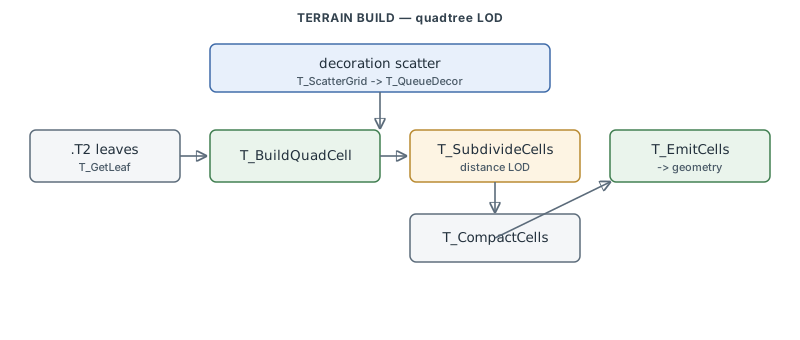
Each frame the visible ground is built as a grid of quad cells in _cellArray:
T_BuildQuadCell samples the .T2 leaf heights at a cell's four corners (T_GetLeaf),
computes a representative altitude (T_QuadAltitude) and a flat-vs-sloped flag
(T_QuadSetFlags). T_ViewBounds rotates the view box by heading to bound the working set;
T_SubdivideCells is the LOD pass — cells nearer the camera subdivide finer;
T_CompactCells drops off-screen cells; and T_EmitCells walks the survivors, looks up each
cell's texture (T_CellTmapLookup), computes normals where sloped (T_Normal), and emits
the geometry via T_LeafOp into the render pipeline.
Decoration scatter¶
Ground decoration (trees, clutter, objects) is data-driven: T_RunAmbientProcs runs up to
17 decoration procs, T_ScatterGrid tiles a 2ⁿ×2ⁿ region calling T_ScatterDecorTile per
tile, which applies per-band distance LOD, gates on the leaf id, samples altitude, and
appends to the decoration queue (T_QueueDecor). T_AddVisibleObjs folds visible world
objects into the same pass.
Functions¶
Full record: db/symbols/terrain.csv.
| VA | Symbol | Role |
|---|---|---|
0x4A9D00 |
T_BuildQuadCell |
build one quad cell (sample corners, altitude, flags) |
0x4A9E20 |
T_QuadAltitude |
representative altitude of a cell |
0x4AA070 |
T_SubdivideCells |
distance-LOD subdivision pass |
0x4AA2B0 |
T_CompactCells |
drop off-screen cells |
0x4AA4A0 |
T_EmitCells |
emit surviving cells' geometry (T_LeafOp) |
0x4A9ED0 |
T_ViewBounds |
rotate the view box by heading |
0x4A8090 |
T_ScatterGrid |
tile the decoration-scatter region |
0x4A8130 |
T_ScatterDecorTile |
place one decoration cluster per tile |
0x4A8C30 |
T_QueueDecor |
append a decoration entry to the queue |
0x4A9C20 |
T_AddVisibleObjs |
fold visible world objects into the pass |
Open Questions¶
1. .T2 sub-header bytes¶
Resolved statically (2026-07-05, #262).
The "sub-header class constants" decode as the .T2 header field map read by the
loader path, which was in the analyzed code all along: T_Load (0x4C5D70)
loads the theater file through RMAccess and relocates two file offsets into
pointers — the tile-summary array (+0x85) and the leaf array (+0x91) — and
T_GetLeaf (0x4C6040) indexes both arrays row-major using the grid fields
(+0x79 leaf step, +0x7D/+0x81 tile grid, +0x89/+0x8D leaf grid). The
payload is two flat arrays, not per-tile records; full field map and the
superseded readings in T2.md.
Status: resolved — see T2.md § Engine Notes.
Related¶
- formats/T2.md — the
.T2terrain heightfield format, and its § Terrain Texturing (per-leaftexture_variant→<theater><N>.PICtile), the model the fxs terrain viewer draws. - render-core.md — the 3D pipeline
T_EmitCellsfeeds geometry into. - collision.md — the terrain grid (
T_GetLeaf/T_Normal) collision uses. - renderer.md — the rasterizer that draws the emitted cells.