Shape Selection & Damage Models
How the game executable chooses which .SH model to draw for a game object — the whole-model
damage swap that replaces an aircraft with a wreck when it is destroyed, and the
per-class variant set (A10_A.SH, A10_C.SH, …) that supplies those wrecks.
Provenance: Ghidra static analysis of the game executable with FA.SMS symbols applied; recovered from
DumpAllFunctions.txt(scripts/ghidra/). Confidence markers follow spec-authoring.md: confirmed · inferred · unknown.
Two axes of shape variation
FA varies an object's geometry along two independent axes, handled by two different mechanisms — keeping them straight is the key to reading this system:
| Axis | Granularity | Mechanism | Where |
|---|---|---|---|
| Detail (distance) and articulation/damage within a model | intra-shape | .SH bytecode opcodes — JumpToLOD, JumpToDetail, JumpToDamage, and the x86 _PL* selectors |
SH.md → Engine Notes |
| Whole-model swap when the object is destroyed | inter-shape | separate .SH files (_A…_D) chosen at render time |
this document |
So A10.SH already contains its own LOD ladder and gear/flap articulation
(intra-shape); the sibling files A10_A.SH…A10_D.SH are destroyed-state
models that the engine substitutes when the aircraft dies. The two never overlap.
The variant set is generated, not authored
The .PT type record names only the primary shape and the shadow (for the A-10:
shape → a10.SH, shadow_shape → a10_s.SH). The lettered variants appear in no
file — the engine derives their names at type-load time.
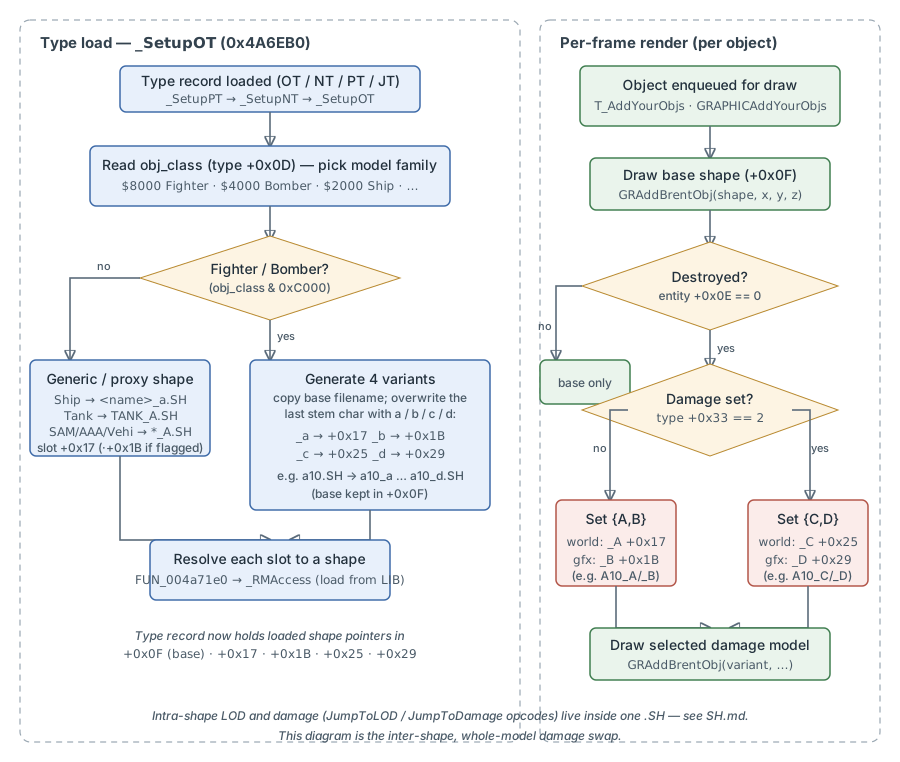
_SetupOT (0x4A6EB0) — reached for every object type via
_SetupPT/_SetupNT/_SetupJT → _SetupOT — copies the base filename and
overwrites the last character of the stem with a/b/c/d, producing the
sibling names, then resolves each through the resource manager
(FUN_004a71e0 → _RMAccess) into a loaded shape pointer stored on the type
record:
a10.SH  (template)  ──▶  a10_a.SH → +0x17   a10_b.SH → +0x1B
                         a10_c.SH → +0x25   a10_d.SH → +0x29
        base kept at +0x0F
How many variants an object gets depends on its obj_class (type +0x0D, the
same bitfield documented in PT.md):
obj_class |
Class | Variants generated |
|---|---|---|
& 0xC000 |
Fighter (0x8000) / Bomber (0x4000) |
full _a _b _c _d set — confirmed |
0x2000 |
Ship | per-ship <name>_a.SH proxy — confirmed |
0x400 / 0x800 / 0x1000 / 0x200 |
Tank / AAA / SAM / Vehicle | shared generic TANK_A.SH / AAA_A.SH / SAM_A.SH / VEHI_A.SH — confirmed |
The _b slot (+0x1B) is additionally gated on a type flag (+0x0E & 0xC0); the
_c/_d slots are built only for aircraft (the & 0xC000 branch). This is
why every aircraft carries four siblings while a tank references one shared shape.
Runtime selection — gated on destruction
The choice is made per object, per frame, in the two draw-enqueue passes. Both
always draw the base shape (+0x0F); then, only when the object is
destroyed — entity health word +0x0E == 0 (the same word ShapeSetup
(0x4AB450) turns into the global _destroyed) and the entity carries the
0x100000 flag — they add a second, whole-model wreck shape:
// _T_AddYourObjs  (world / terrain pass)      // _GRAPHICAddYourObjs (graphics pass)
if (entity[0x0E] == 0 && (entity[1] & 0x100000)) {
    variant = (type[0x33] == 2) ? type[0x25]   //   variant = (type[0x33]==2) ? type[0x29]
                                : type[0x17];   //                              : type[0x1B];
    GRAddBrentObj(variant, x, y, z);            //   GRAddBrentObj(variant, ...);
}
The per-type field +0x33 selects between two damage-model sets: {_A, _B}
when +0x33 != 2, {_C, _D} when +0x33 == 2. Within a set, one variant is
drawn in the world/terrain pass (_A or _C) and its partner in the graphics
pass (_B or _D). Distance never enters this decision — LOD is entirely
intra-shape.
+0x33 is not authored in the type file — it is written at the moment of
destruction. PLANEBreakUp (0x49D730, the flight model's break-up handler)
sets damage_set = _Rand(2) + 1 (so 1 or 2) as it raises the destroyed
flags, then chooses ground vs. air debris. A value of 2 routes the object to
the {_C, _D} set, 1 to {_A, _B} — i.e. the wreck pair is picked at random
per kill, which is why the same airframe shows either the torn-airframe or the
flat-silhouette wreck across replays.
Worked example — the A-10 family in FA_2.LIB
| File | Faces | Bounds (ft) | Role | Evidence |
|---|---|---|---|---|
A10.SH |
81* | X ±81 | in-flight model (articulated, x86 _PL* selectors) |
base slot +0x0F; gear/flap trampolines |
A10_A.SH |
432 | X −87..80 | destroyed set {A,B} — world pass |
slot +0x17 |
A10_B.SH |
98 | X ±13 | destroyed set {A,B} — graphics pass |
slot +0x1B |
A10_C.SH |
398 | X −45..84 (asymmetric) | destroyed set {C,D} — world pass |
slot +0x25; torn airframe |
A10_D.SH |
80 | X −54..27, Z −2..3 (flat) | destroyed set {C,D} — graphics pass |
slot +0x29; ground wreckage |
A10_S.SH |
6 | Z = 0 | shadow | .PT shadow_shape |
*A10.SH reports 81 extracted faces because the rest of its geometry sits
behind x86 selector blocks the fx codec skips — see
SH.md → X86Unknown Region. Its true face count is
comparable to A10_A.
The geometry corroborates the trace: A10_C is laterally asymmetric (one side
torn away) and A10_D is flat (a burnt ground silhouette) — destruction, not
detail reduction.
Object-type record — shape fields
Recovered subset of the OT/NT/PT/JT type record (the struct _SetupOT operates
on; distinct from the per-instance entity struct). Offsets are from
the type-record base.
| Offset | Size | Field | Meaning | Confidence |
|---|---|---|---|---|
+0x0D |
2 | obj_class |
class bitfield (drives variant generation) | confirmed |
+0x0E |
1 | type_flags |
& 0xC0 enables the _b slot |
inferred |
+0x0F |
4 | shape |
base shape → loaded pointer | confirmed |
+0x13 |
4 | shape_name |
filename used as the suffixing template | confirmed |
+0x17 |
4 | shape_a |
_a variant (loaded) |
confirmed |
+0x1B |
4 | shape_b |
_b variant (loaded) |
confirmed |
+0x25 |
4 | shape_c |
_c variant (loaded), aircraft only |
confirmed |
+0x29 |
4 | shape_d |
_d variant (loaded), aircraft only |
confirmed |
+0x33 |
4 | damage_set |
== 2 selects the {_C,_D} set; written _Rand(2)+1 by PLANEBreakUp |
confirmed |
Instance-side fields this system reads (see structs.md): entity
+0x05 → type record, +0x0E health word (0 = destroyed), +0x01 & 0x100000
damage-model flag.
Functions
| VA | Symbol | Role |
|---|---|---|
0x4A6EB0 |
_SetupOT |
generate the lettered variant names and load every shape slot |
0x4A7200 / 0x4A7220 / 0x4A7230 |
_SetupNT / _SetupPT / _SetupJT |
per-type-kind entry points → _SetupOT |
0x4A71E0 |
LoadShapeSlot |
resolve one slot's name to a loaded shape via _RMAccess |
0x4A6B10 |
ResolveTypeRecord |
return the type-record pointer via the MM handle at +0x0F (_SetupOT's first step) |
0x4A6AE0 |
_RMAccess@8 |
resource-manager load/lock by name |
0x4A7A40 |
_T_AddYourObjs@0 |
world/terrain draw-enqueue; selects _A/_C |
0x4431B0 |
_GRAPHICAddYourObjs@4 |
graphics draw-enqueue; selects _B/_D |
0x4D057C |
_GRAddBrentObj@40 |
queue a shape into the render-sort list (consumes the SH header) |
0x4AB450 |
@ShapeSetup@4 |
per-object shape-state init; derives _destroyed from the health word |
Open questions
1. damage_set (+0x33) derivation — resolved
+0x33 is written at destruction time by PLANEBreakUp (0x49D730) as
_Rand(2) + 1, so the {_A,_B} vs {_C,_D} wreck pair is chosen at random per
kill rather than fixed per aircraft (see above). No longer open.
Status: resolved — re-static.
Related
- objects.md — the entity/object system that owns the type record and runs the destruction path.
- SH.md — the shape format; intra-shape LOD/damage/articulation
opcodes and the x86
_PL*selectors (the other variation axis). - PT.md — the plane-type record whose
obj_classand shape fields feed this system. - structs.md — the per-instance entity struct (health word, type pointer, flags).
- renderer.md — the render-sort pipeline
GRAddBrentObjfeeds.