AI Interpreter — "Chuck Talk" (CT)
The bytecode virtual machine that runs the game's .AI behaviour scripts. CT is not
"control/tactics" — the interpreter's own error path prints "Chuck Talk error: %s,
line %u", so CT = Chuck Talk, the internal name of the .AI scripting language.
The VM lives at 0x464C60–0x467110; it runs the compiled .BI bytecode
(BI.md) that .AI source (AI.md) compiles to.
Provenance: Ghidra static analysis of the game executable with FA.SMS symbols applied; every symbol here is recorded in the symbol database and applied to the Ghidra project (the ~95
CTEval_*/CTDo_*handlers are label-only in FA.SMS and are materialised as functions on apply). Progress is tracked in the reconstruction matrix. Confidence markers follow spec-authoring.md: confirmed · inferred · unknown.
Two-tier dispatch with a JIT inline cache
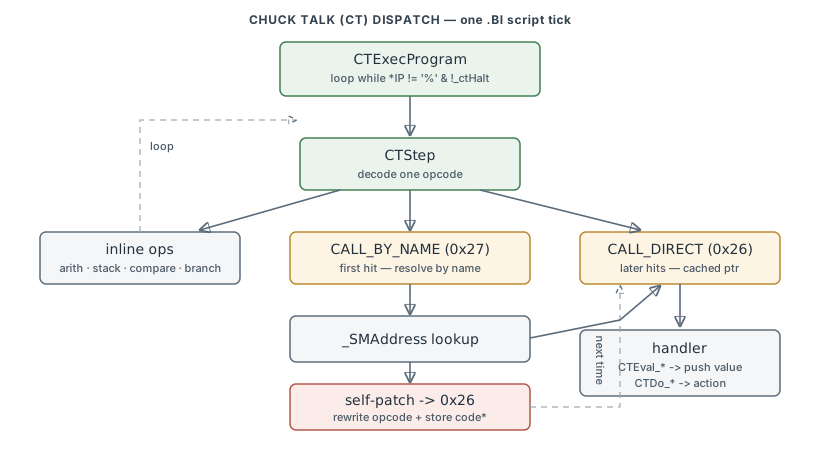
CTExecProgram (0x466970) is the entry and loop. It is called with an event
priority; a running lower-priority script is preempted when a higher-priority event
arrives (_PLANEEventProc/_GVEventProc call it with 5 for a hit/threat down to 0
for the default-waypoint behaviour). Per call it restores the saved state, reloads the
program if the incoming priority beats the saved one, then runs
while (*IP != '%' && !_ctHalt) stepping one opcode at a time (capped at 5000/tick).
CTStep (0x466A80) decodes one opcode and dispatches through a C switch (a jump
table) over 0x00–0x28 — arithmetic, compare, stack, and control-flow are inline
(matching BI.md's opcode table). The condition and action handlers are
reached through two call opcodes that form an inline cache:
CALL_BY_NAME(0x27) resolves the inline handler name via_SMAddress(the Phar Lap symbol manager), calls it, then self-patches the bytecode: the opcode is rewritten toCALL_DIRECT(0x26) with the resolvedcode*stored inline. First hit resolves by name; every later hit is a direct call.
This is the game-executable-resident-handler / BI-supplies-bytecode split — the same architecture as the SH interpreter (shape-selection.md / SH.md), differing only in that CT resolves handlers by name-and-self-patch rather than a fixed vector table.
Conditions, actions, and state
The call targets are two families: CTEval_* stateless condition/attribute readers
(CTEval_tgt, CTEval_disttotgt, CTEval_ir, …) that read the actor's live entity
fields and push a value, and CTDo_* actions (CTDo_turn, CTDo_move,
CTDo_wm_formation, …) that pop typed arguments through the readers (CTReadHeading,
CTReadSpeed, … — all normalising to binary degrees ×182 and clamping to the aircraft's
limits) and drive the maneuver engine. The *diff conditions are all built on
CTVarDiff, which evaluates the same attribute twice — for the actor and, via
Push/PopCurObj, for the compared object — and subtracts.
There is one shared interpreter context: the 0x80-byte _ctState block (script
variables, a ~20-deep eval stack, the instruction pointer, the loaded program base and
name, the current line and priority). Per-object continuity comes from checkpointing:
CTSaveState copies the live block to a heap checkpoint and zeroes it; CTRestoreState
copies it back. So per-object AI is objects' entity fields feeding stateless evaluators,
over a single preemptible, checkpointed VM.
Functions
Representative subset; the full record (incl. all CTEval_*/CTDo_* handlers) is in
db/symbols/ai.csv.
| VA | Symbol | Role |
|---|---|---|
0x464C60 |
CTInit |
zero the interpreter state |
0x466970 |
CTExecProgram |
interpreter entry/loop; priority-preemptible |
0x466A80 |
CTStep |
decode + dispatch one opcode; the CALL_BY_NAME→CALL_DIRECT cache |
0x464CD0 |
CTLoadProgram |
load/switch the .BI CODE resource by name |
0x464DB0 |
CTResetPC |
reset the instruction pointer to the program base |
0x466920 |
CTSaveState |
checkpoint _ctState to the heap |
0x4668F0 |
CTRestoreState |
restore _ctState from the checkpoint |
0x466290 |
CTPush |
eval-stack push (overflow → CTError(5)) |
0x465AD0 |
CTPop |
eval-stack pop (underflow → CTError(4)) |
0x4670E0 |
CTVarPtr |
resolve a script variable slot (0–4) |
0x466820 |
CTError |
raise a "Chuck Talk error" and exit |
0x465C90 |
CTReadAngle |
pop + clamp to ±90° in binary degrees |
0x465E00 |
CTReadSpeed |
pop + clamp to the aircraft's speed envelope |
0x464DE0 |
CTVarDiff |
evaluate an attribute for actor vs compared object and subtract |
0x464F10 |
CTEval_tgt |
condition: does the actor have a target |
0x465220 |
CTEval_disttotgt |
condition: distance to target |
0x465EA0 |
CTDo_turn |
action: turn to a heading |
0x465CC0 |
CTDo_move |
action: move toward a point |
0x464C90 |
CTRespondToCancelCmdBuf |
re-enter the script after a command-buffer cancel |
Open Questions
1. Who writes _ctCheckPass (0x546C8C)? — resolved
Nobody, in the game executable. A whole-program scan of the decompile finds all 11 references to
_ctCheckPass are reads (== '\0' / != '\0' gates); there is no write, address-of, or
bulk initialiser anywhere in the image. So at runtime it is a constant 0, and every branch it
guards (the validate/dry-run path unlocking the syntax-error / expecting-var / stack-imbalance
CTError diagnostics) is dormant in the shipped game. This confirms the read: the CT core
doubles as the .AI→.BI compiler's validator, and the flag's setter lives in that offline
compiler tool, which is not linked into the game executable — the game executable ships only the interpreter, so it never
runs the load-time verification pass.
Status: resolved — re-static (no writer in the game executable; validator dormant).
2. _ctState + 0x7c/0x7e (FRAME) semantics — characterized
The two s16 at the tail of _ctState are touched only by the bulk CTSaveState
(0x466920) / CTRestoreState (0x4668F0) snapshot copy — there is no scalar read or write
anywhere in the game executable. Statically that is all that can be established: they are opaque
saved-and-restored interpreter state with no in-binary accessor, so their runtime meaning (the
suspected maneuver-frame / animation-phase stamp) cannot be pinned by static RE alone — it would
need the running game or the .AI compiler. Documented as characterized rather than left open,
since a further static pass cannot resolve it.
Status: resolved (characterized) — no scalar accessor in the game executable; runtime meaning needs #56.
Related
- formats/AI.md / formats/BI.md — the Chuck Talk source and compiled-bytecode formats this VM runs.
- objects.md — the entity mirror whose fields the
CTEval_*readers sample. - The WNG/GRP formation engine the
CTDo_wm_*actions drive (#217, forthcoming). - shape-selection.md — the sibling SH bytecode interpreter.