Wingman / Group AI (WNG / GRP)
Formation and flight/group management: WNG_* manages aircraft wings (a leader plus up
to 9 wingmen), GRP_* the byte-identical twin for ground/naval groups. This is the
executor the AI interpreter's wm_* commands drive. 0x45E460–0x45FEC0.
Provenance: Ghidra static analysis of the game executable with FA.SMS symbols applied; recorded in the symbol database and applied to the Ghidra project. FA.SMS exported the full
GRPAPI but only part ofWNG; every unnamed WNG function is the exact GRP twin (withGRP→WNG), which is how all 15 recovered names are pinned. Progress: reconstruction matrix. Markers follow spec-authoring.md: confirmed · inferred · unknown.
Data model
A wing is _wingIds[wing*10 + slot] (ushort ids; slot 0 = leader, 1–9 = wingmen) with
_wingSizes[wing] the count — up to 10 wings, 10 groups. GRP is the same on
_groupIds/_groupSizes. There are 8 formation types (_fTypeOffsets, 8×10 slot offsets;
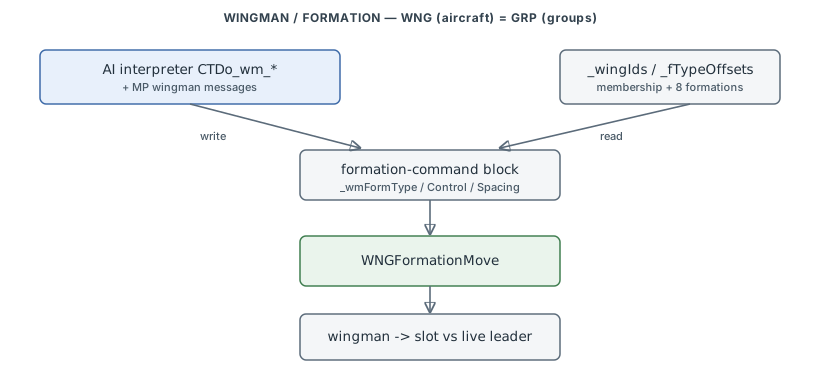
_wmFormType selects). The formation-command block (_wmFormControl/_wmFormType/
_wmFormSpacingH/_wmFormSpacingV, plus the shared target) is the control surface both the
AI interpreter and multiplayer messages write.
Commands: AI interpreter → WNG/GRP
The Chuck Talk AI interpreter's wm_ opcodes map 1:1 onto the
formation surface: CTDo_wm_hspacing/vspacing/formation/control set it, and
CTEval_wm_*_is read it back. Execution reaches WNG/GRP two ways — direct calls on the
current object (_GVEventProc → GRPSetType/SetControl/…), or via _MSGSend wingman
messages (0x8001/0x8002) whose subcode dispatch in _PLANEEventProc calls the WNG
setters (7=SpacingH, 8=SpacingV, 9=Type, 10=Control, 0x0B=attack, 0x0C/0x0D=engage,
0x11=cover-me). WNGSendWM(' ', target) fans an attack order out to all qualifying wingmen.
Formation-keeping
WNGFormationMove indexes slot + formType*10 into _fTypeOffsets for a (dx,dy,dz) unit
vector; the target point = (dx·spacingH + jitterX, dy·spacingV + jitterY, dz·spacingH +
jitterZ) relative to the live leader (WNGLeader returns the first living member, so
formation survives leader loss), then CreateMove issues the move order. Jitter is
re-rolled on an interval for natural drift.
Functions
Full record: db/symbols/wingman.csv.
| VA | Symbol | Role |
|---|---|---|
0x45E460 |
WNGInit |
zero all wing arrays and formation scalars |
0x45E490 |
WNGAdd |
add the current object to a wing slot |
0x45E710 |
WNGPart |
find id → (wing, slot); leader/wingman test |
0x45E630 |
WNGLeader |
first live member of a wing |
0x45E6E0 |
WNGWingmen |
the wingmen list (slots 1..n) |
0x45E970 |
WNGFormationMove |
position a wingman in formation vs the leader |
0x45ED90 |
WNGSendWM |
dispatch a wingman-message opcode (fan out orders) |
0x45EB30 |
WNGSetType |
set the formation type |
0x45EAC0 |
WNGSetControl |
set the formation control level |
0x45EBF0 |
WNGSetStateTarget |
enter a state + set the shared target |
0x45F190 |
GRPInit |
ground/naval-group twin of WNGInit |
0x45F1C0 |
GRPAdd |
group twin of WNGAdd |
0x45F440 |
GRPPart |
group twin of WNGPart |
0x45FC50 |
GRPAttackingObj |
count group members attacking a target |
Open Questions
1. _wmFormControl semantics
Set to 1 on Add and clamped in SetControl with a two-sided comparison; WNGSendWM
early-outs when it is > 1. Whether it is a boolean "hold formation", a member count, or a
tightness level needs the CT wm_control argument range — a bench (re-gameplay) check.
Status: open — re-gameplay (#56).
Related
- ai-interpreter.md — the Chuck Talk
wm_*opcodes that drive this. - objects.md — the entity/message system carrying wingman commands.
- physics.md —
CreateMove/ the flight model that executes formation moves.